
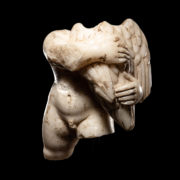
Ancient Roman Marble Cupid with a Bird
A small, statuette-size sculpture represents Cupid (Eros in Greek art) holding a big bird against his chest. The motif comes back to the Hellenistic art that introduced several charming representations of children or Erotes with their pets, little dogs or birds
Stela representing a Woman
The stele is like a large, almost rectangular slab. It depicts the bust of a woman with a somewhat stiff and impersonal expression, carved in very high relief. The base, the back and the sides are flat and roughly hewn: it is possible that it served as a funerary stele.
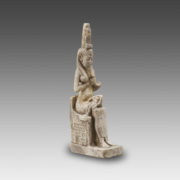
Amulet representing Isis Lactans
Egyptian faience Amulet representing Isis Lactans from the 7th-1st century B.C. Isis is seated on a low-backed, richly ornamented throne. The goddess holds little Horus on her knees, whom she is breastfeeding. She wears a finely braided wig surmounted by a small throne, Isis’s primary attribute. Complete and in good condition even if Horus’ head and the left hand of the goddess are lost.
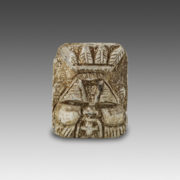
Amulet representing the head of Bes
Egyptian faience amulet representing the head of Bes from the 3rd Intermediary Period. Complete and in good condition despite few chips on the crown, the mask and the ears.
Bottle with Decorations
With no handles, this richly decorated bottle has a spherical yet flattened body, supported by a small ring-shaped base. It was probably used for serving drinks, as a piece of tableware.
Statuette of a Wild Sheep or a Ram
This Statuette of a Wild Sheep or a Ram was carved from a thin stone pebble, which is still partially translucent, despite the current dark and worn appearance of the surface.
Seal in the Shape of a Lion’s Head
Modeled in the shape of a stylized leonine protome (the head is complete, but the body is a simple half-circle representing the mane of the animal), it was carved from a cream-colored limestone veined with red; it is pierced vertically by a hole and was therefore intended to be worn as a pendant (necklace or bracelet).
The flat lower part of the object actually bears the seal of the owner and of his goods: it is adorned with drawings made with a bouterolle (a sort of drill).
Statuette of an Elephant
Carved from a small limestone monolith, this statuette is certainly one of the first three-dimensional images of elephant in Near Eastern art; moreover, these large mammals were rarely represented in the rich animal iconography of this prominent culture.
Seal in the shape of a Pig
This seal, modeled in the shape of a stylized pig (the head is complete, but the body is a simple half-circle), was carved from a cream-colored limestone; it is pierced by a hole and was therefore intended to be worn as a pendant (necklace or bracelet).
Greek terracotta figure showing the myth of Europe
The group comprises two figures: with natural grace, a young woman rides astride a bull that is galloping rapidly towards the viewer’s right. Indeed, the young woman is Europa (the mythological figure after whom our continent is named), who was one of the three daughters of the King of Tyre (a major Phoenician coastal city). She was abducted by Zeus on the beach where she was playing with her sisters: the god appeared to her in the form of a magnificent white bull and carried her, riding the waves of the sea, all the way to Crete.
Mummy Faience Bead Mask
This mask, delineated by three fringes of white, red and black beads, clearly highlights the anatomical details connected with the senses: the ears, the eyes with the black irises, the nose and the mouth made of red beads.
Shield-Shaped Anatolian Idol
The figurine is flat and slightly rounded. The shield-shaped outline, typical of these idols known as “schematic”, probably represents the silhouette of a seated human body, but without any volume.
©Designed by Webgenève - Création de site internet

Rue Etienne Dumont, 9 1204 Geneva
Tel. +4122 301 9378
Email: contact@young-collectors.com