
Stela representing a Woman
The stele is like a large, almost rectangular slab. It depicts the bust of a woman with a somewhat stiff and impersonal expression, carved in very high relief. The base, the back and the sides are flat and roughly hewn: it is possible that it served as a funerary stele.
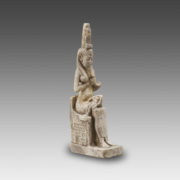
Amulet representing Isis Lactans
Egyptian faience Amulet representing Isis Lactans from the 7th-1st century B.C. Isis is seated on a low-backed, richly ornamented throne. The goddess holds little Horus on her knees, whom she is breastfeeding. She wears a finely braided wig surmounted by a small throne, Isis’s primary attribute. Complete and in good condition even if Horus’ head and the left hand of the goddess are lost.
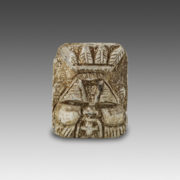
Amulet representing the head of Bes
Egyptian faience amulet representing the head of Bes from the 3rd Intermediary Period. Complete and in good condition despite few chips on the crown, the mask and the ears.
The Pendant / Amulet with the Head of Bes
It is in the shape of a small flat bust, with a slightly rounded bottom. At the level of the crown, it is pierced horizontally for a suspension string, which would have allowed the amulet to be worn as a necklace, for example.
Egyptian Anepigraphic Scarab
The scarab is placed on a flat, elliptical base; the bottom has no inscription. Characterized by stylized, though complete and accurate shapes, this beetle shows elegant features that indicate the details of the anatomy.
Amulet of a standing Bes
As usual, Bes sports a grimacing, grotesque expression, which makes him appear almost hilariously amused and thus portrays him as a positive and benevolent figure: his face is flattened and viewed from the front, with a wrinkled forehead crossed by thick eyebrows, wide-open eyes, a broad, flattened nose, ears reminiscent of a feline’s, and a beard ending in large, spiraling curls.
Mummy Faience Bead Mask
This mask, delineated by three fringes of white, red and black beads, clearly highlights the anatomical details connected with the senses: the ears, the eyes with the black irises, the nose and the mouth made of red beads.
White-glazed Egyptian Faience Ushabti (Dynasty 21-22)
This ushabti represents a male figure with a short false beard and a rounded wig, only painted on the front part of the statuette. From the late New Kingdom on, the iconography and the purpose of the ushabtis were standardized: from substitutes for the deceased, these figurines became slaves and served their masters in the chores of daily life.
©Designed by Webgenève - Création de site internet

Rue Etienne Dumont, 9 1204 Geneva
Tel. +4122 301 9378
Email: contact@young-collectors.com