
Amulet representing the head of Bes

Amulet representing the head of Bes
Amulet representing the head of Bes
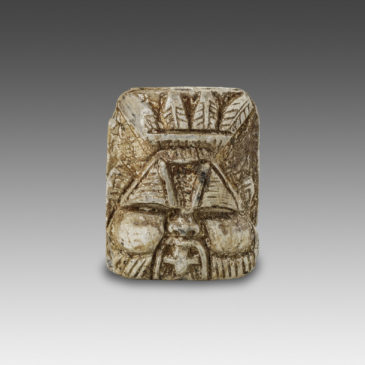
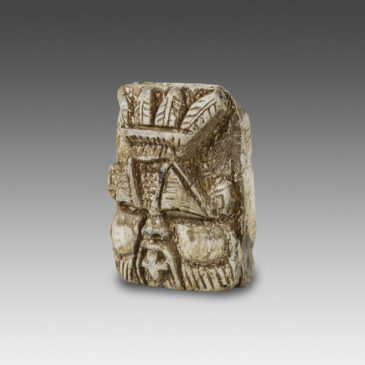
Egyptian faience amulet representing the head of Bes from the 3rd Intermediary Period. Complete and in good condition despite few chips on the crown, the mask and the ears.
10th century B.C., 8th century B.C.
Dim : 2.5 x 2.0 cm
Product Description
Egyptian faience amulet representing the head of Bes from the 3rd Intermediary Period. Complete and in good condition despite few chips on the crown, the mask and the ears.
The pendant/amulet takes the form of a small, flat bust with a slightly rounded base. At the crown, it has a horizontal hole through which a string was threaded, allowing the object to be worn, for example, as a necklace pendant.
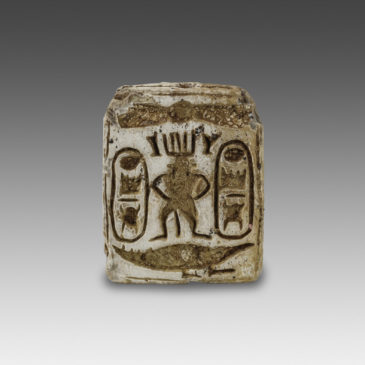
The head, carved in slight relief, depicts the mask of the god Bes, which, as a pars pro toto, represents the entire figure of this deity. Despite a certain degree of stylization, the god’s mask appears here in its grotesque form: a flattened face viewed from the front, a deeply furrowed brow, wide-open eyes, a flat nose, lion-like ears, broad, flattened cheeks, and a long beard with incised strands. On his head he wears the customary headdress made of feathers, rendered by simple vertical lines. At the back, despite its small size, the flat surface is decorated with several engraved motifs: among them, a crocodile (symbol of the spirit of the waters), a stylized Bes, the winged solar disk (Horus of Behedet), and two identical cartouches, which bear one of Thutmose III’s names, Men-Kheperre, whose protective power has been attested for centuries.
Bes is a little genius, already known in the Old Kingdom, but whose popularity began to take shape primarily during the New Kingdom; he became one of the most popular figures in the Egyptian pantheon beginning in the Third Intermediate Period and continuing throughout the first millennium B.C. He was particularly protective of women and children: thanks to his ugliness and fearsome appearance, he warded off misfortune and disease from them and served as the guardian of the expectant mother’s health and the fragile fate of the newborn. Bes was also the protector of female musicians and dancers.
As prime examples of popular piety, figurines and images of this god were widespread throughout the Egyptian world: used as talismans, they could be worn as pendants on jewelry, hung on a door or in a room, strung on a stick or pole and placed at the corners of a bed, etc.; some pieces may have served as rattles for children.


