
« Token » with Flower Pattern

« Token » with Flower Pattern
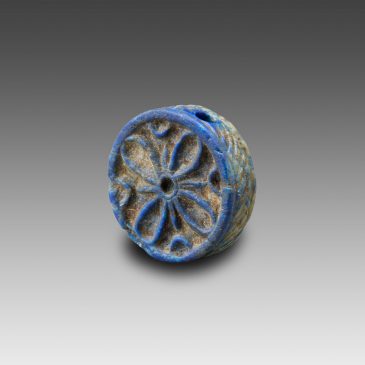
The ‘token’ (the term is chosen solely because of its shape, with no reference to its ancient use, which is currently unknown) is carved from a small lapis lazuli pebble of a beautiful azure blue, veined with grey in places.
In stock
Product Description
The ‘token’ (the term is chosen solely because of its shape, with no reference to its ancient use, which is currently unknown) is carved from a small lapis lazuli pebble of a beautiful azure blue, veined with grey in places. It is shaped like a small but rather thick disc (8–9 mm thick). A hole four millimetres in diameter runs through the edge. On both sides, the decoration is virtually identical (though its orientation is slightly offset): four petals, raised in relief at the edges and emerging from a central circle, form a flower. Cross-shaped lines and semicircles complete the design, whilst a frieze of slanted lines adorns the entire edge.
Only a few other similar ‘tokens’ are known: decorated with figurative scenes, they date from the second half of the third millennium BCE. Strung on a piece of string or mounted on a bronze pin (the example in the Louvre still has the remains of a pin in the hole), they may have been used as pendants or as decorative items. The fact that all these objects are engraved on both sides rules out their use as seals
The most significant lapis lazuli deposits known in antiquity are situated in the mountain ranges of present-day Afghanistan (which the Greeks and Romans called Bactria), Pakistan and Tajikistan: although a few lapis lazuli artefacts are known to date back to the Neolithic period, it was from the 4th and 3rd millennia BC onwards that this important mineral resource began to be traded regularly between the Middle and Near East, as it was exported as far afield as Iran, Mesopotamia, the Mediterranean coast and Egypt. Lapis lazuli was a highly prized semi-precious stone, used in the manufacture and decoration of luxury items (architecture, sculptures, vessels, etc.) as well as in goldsmithing.


