
Statuette of a Dwarf Warrior

Statuette of a Dwarf Warrior
Statuette of a Dwarf Warrior
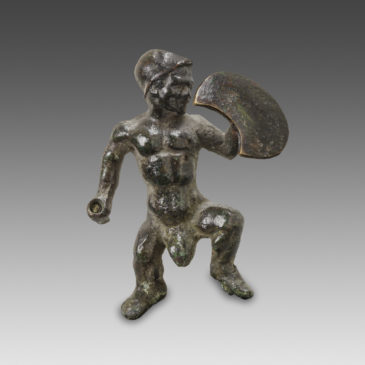
Early Imperial Romain Bronze Statuette of a Dwarf Warrior from the 1st-2nd century A.D. The statuette, made of solid bronze, was cast using the lost-wax technique. The statuette, made of solid bronze, was cast using the lost-wax technique. It was attached to its base (of which no trace remains) by a tenon visible beneath the raised foot.
1st century A.D., 2nd century A.D.
H : 5.1 cm
Product Description
Early Imperial Romain Bronze Statuette of a Dwarf Warrior from the 1st-2nd century A.D. The statuette, made of solid bronze, was cast using the lost-wax technique. It was attached to its base (of which no trace remains) by a tenon visible beneath the raised foot.
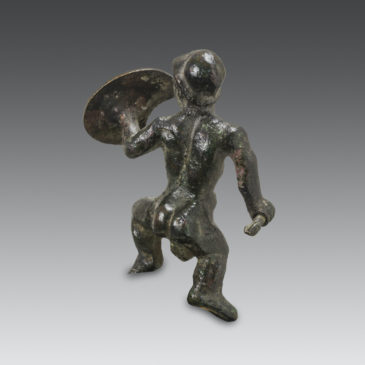
Some surface wear makes it difficult to assess the artistic quality of the depiction. However, it is worth noting the precision of the observation and the realistic depiction of his posture, which is quite distinctive: his legs are spread apart and positioned on two different levels; his torso is viewed from the front; and his head and shield are turned to the right—all of which indicate that the dwarf was standing on steep terrain and fighting an enemy positioned to his left and slightly higher than him. In his struggle, he uses a dagger as an offensive weapon (of which only the hilt remains, visible in his right hand), while protecting himself with the small, crescent-shaped shield (a pelta), which is cast directly onto the end of his arm (the hand, invisible to the viewer, is not depicted in detail); on his head, he wears a headdress reminiscent of a Corinthian helmet. The figure’s genitals are disproportionately large.
Unfortunately, nothing is known about the statuette’s context in antiquity or how it was displayed (as part of a group, as a decorative element on a candelabrum, etc.).
The figurine’s proportions are typical of ancient depictions of dwarfs. Although the ancients did not have the scientific means to describe the various forms of physical abnormalities known as dwarfism, they were able to depict their most obvious external characteristics. Among the different known forms of this condition, disproportionate dwarfism (achondroplasia) is the one that appears most frequently in nature as well as in Greco-Roman iconography: depictions of dwarfs are generally characterized by disproportionate limbs, an oversized head, a flat face, a prominent belly and buttocks, a tendency toward obesity, and possibly a spinal deformity, among other features. Another frequently depicted anomaly—though one with no scientific basis—is an oversized penis.
Several characteristics of dwarfism are evident in the statuette under examination: in particular, the length of the legs and arms, which are too short in relation to the torso, as well as the apparently excessive curvature of the back. It is no longer possible to identify this figure, but one can note the focused expression on his face, entirely absorbed in the action: unlike many figurines of this type, which are “grotesque” in nature, this man’s physical deformity is portrayed with realism and respect. Like hunchbacks, dwarfs are frequently depicted in Greco-Roman art; in fact, they appear far more often than the actual proportion of people affected by this deformity. This phenomenon is likely due to the apotropaic and good-luck significance attributed to people with such disabilities; the abnormal size of their genitals is probably explained by the same belief.


