
Statuette of a Dwarf Silene

Statuette of a Dwarf Silene
Imperial Romain Bronze Statuette of a Dwarf Silene
from the 1st-2nd century A.D.
In very good condition with superb patina even if the right hand is lost.
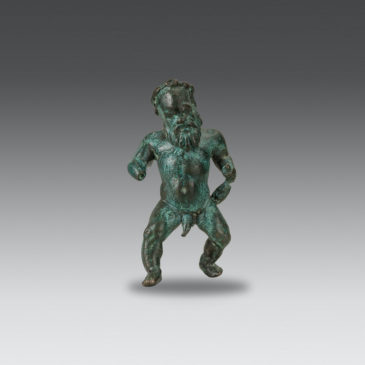
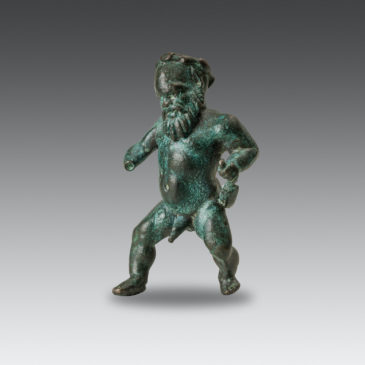
He is identified as Silenus by his pointed ears, snub nose, and the wavy incisions on his body, which indicate that he was once hairy. His head is crowned, and in his left hand he holds a bunch of grapes.
1st century A.D., 2nd century A.D.
H : 7 cm
Product Description
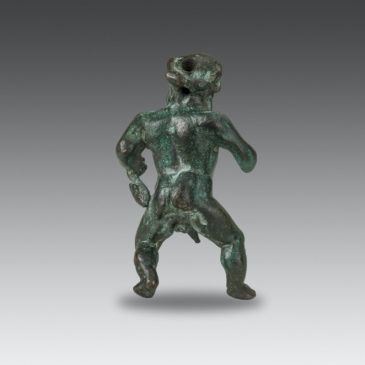
The statuette was cast in solid iron using the lost-wax technique. At the back of the head, a long hole pierces the nape of the neck: its purpose cannot be explained with certainty, but it is thought to have been part of the mechanism used to attach the statuette to its original support (an ornament for a candelabrum or a vessel, part of a small group of statuettes depicting Dionysian subjects, etc.). The Silenus, whose body is leaning backward, cannot stand on his own: his legs are slightly bent, the right one is stepped forward, while the left one is set back, as if the figure were dancing or skipping.
The statuette displays exceptional technical and artistic quality: the anatomical details are highly realistic and rendered through remarkable sculptural craftsmanship, which precisely alternates between well-modeled forms and small indentations.
He is identified as Silenus by his pointed ears, snub nose, and the wavy incisions on his body, which indicate that he was once hairy. His head is crowned, and in his left hand he holds a bunch of grapes.
The proportions of the figurine are typical of ancient depictions of dwarfs. Although the ancients did not have the scientific means to describe the various forms of physical abnormalities known as dwarfism, they were able to portray their most obvious external characteristics. Among the various known forms of this condition, disproportionate dwarfism (achondroplasia) is the one that appears most frequently in nature as well as in Greco-Roman iconography: depictions of dwarfs are generally characterized by disproportionate limbs, an oversized head, a flat face, a prominent belly and buttocks, a tendency toward obesity, and possibly a spinal deformity, among other features. Another common anomaly in iconography—though one with no scientific basis—is the disproportionately large size of the genitals.
Several characteristics of dwarfism are evident in the statuette under examination: the unusual proportions of the legs and arms, which are too short and muscular; the head, which is too large; the partially twisted legs; the slightly protruding belly; and the arched back.
Like hunchbacks, dwarfs feature prominently in the “grotesque” depictions of Greco-Roman art: their frequency is, in fact, well above the average number of people actually affected by this condition. This phenomenon is likely explained by the the belief that people with such disabilities had apotropaic and lucky-charm properties; the abnormal size of their genitals is likely explained by the same belief.
Imperial Romain Bronze Statuette of a Dwarf Silene from the 1st-2nd century A.D. In very good condition with superb patina even if the right hand is lost.


