
Ancient Corinthian Greek Terracotta Lekanis with Panthers, a Sphinx, and Harpies
The lekanis has twin spurred handles on either side of a shallow footed bowl, decorated by three rows of red pomegranates along the rim and a series of red, black, and clay colored bands below
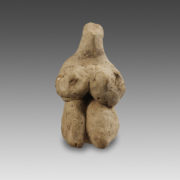
Miniature Feminine Statuette
This Near Easter Terracotta Miniature Feminine Statuette is considered as a Tell Halaf Statuette, as she features their style, typology and technique. It depicts a female figure seated with her knees bent and drawn up towards her body; her arms are wrapped around her enormous breasts.
Hunchback Statuette (?)
Hand-modelled, the sculpture depicts a figure of indeterminate gender, characterised above all by the obvious deformation of its spine: its back forms a large hump, emphasised by the spine, which is slightly raised, and by the rendering of the ribs, painted dark brown. This deformity causes the figure’s torso to lean abnormally forwards and to the left.
Polychrom Askos with two necks
A small but charming example of an ‘askos’ form, one of the most significant in Daunian pottery from the early Hellenistic period. Here, the usual wide neck is complemented by a second, symmetrical spout, fitted with a strainer and positioned at the rear of the body.
Skyphos with Linear Decoration
The skyphos is a vessel designed primarily for drinking wine at banquets (symposia): the term refers to a rather deep, elegantly shaped cup with two horizontal handles, which was particularly common in Corinth. It is sometimes also called a kotyle.
Iapygian Spherical Jug
The shape and style allow this vessel – a known but relatively rare type – to be dated to the early phase of Daunian pottery development, characterised by high-quality pieces and predominantly geometric decoration: the presence of sculptural elements, such as the animal head on this jug, is well documented.
Iapygian Thymiaterion
The thymiaterion was a funeral vessel, very rare in the repertoire of Daunian pottery, which was generally used to make offerings and to burn scented substances.
Daunian Askos with a Linear Decoration
The word askos originally designates the skin of an animal that was sewn and turned into a skin intended to carry liquids, especially wine or water. This example, whose spherical shape with a large vertical neck recalls a wineskin, is a typical production of Daunian ceramists
Islamic Bowl with Abstract Decoration
A light beige-gray ceramic bowl, covered with a white slip; the decoration is painted in black under a beautiful turquoise glaze, thicker on the bottom where it partially dripped. This manufacturing technique, known as metal luster technique, is among the most important contributions of Islamic craftsmen to the development of ceramics.
Ex-Voto in the shape of a Female Head
This veiled female head is carved in very high relief on the plaque, whose edges are curved. The two vertical edges, visible in the lower plaque, indicate the borders of the veil. Such protomes were largely widespread in the Greek world, in Attic but also in Eastern Greece and in the Western colonies, between the 6th and the early 5th century B.C.
Near Eastern Seated Statuette
The figure, whose gender is not clearly defined (the absence of breasts and the low-detailed shapes would rather suggest a male body), is seated on a cubic stool without any carved details. The torso of the figure is straight, the back is smooth and without details; the legs are simple rods in light relief. The arms of the figure are folded and the triangular hands are brought back to the chest.
©Designed by Webgenève - Création de site internet

Rue Etienne Dumont, 9 1204 Geneva
Tel. +4122 301 9378
Email: contact@young-collectors.com