
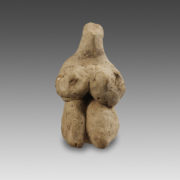
This Near Easter Terracotta Miniature Feminine Statuette is considered as a Tell Halaf Statuette, as she features their style, typology and technique.
Early Imperial Romain Bronze Statuette of a Dwarf Warrior from the 1st-2nd century A.D. In very good condition with an interesting dark brown patina. The dagger is broken and the blade lost.
Mycenaean Terracotta Statuette in T Symbol from the 14th-13th century B.C.
Like almost all Syrian terracotta statuettes dated to this period, this figurine was hand-modeled in a very stylized, almost instinctive manner; it is seated on a simplified stool.
This turned bowl is made of beige ceramic covered with a red slip; decorated patterns are painted on the inner wall of the vessel only, with thick lines and in blackish brown color.
The bowl is perfectly turned. The ceramic is beige, but the surface is entirely covered with colored paint. The element that makes this piece a very special, perhaps unique object, is certainly the statuette of the quadruped.
Vessels in the shape of dates, which look very realistic with the vertical grooves imitating the wrinkles of the dried fruit, are among the most famous and popular glass vases of the early Imperial period.
Among the most common forms of Near Eastern pottery, the bowl without handles is presented here in a particular version, with a conical shape.
This core-formed bowl is simply decorated with lathe-cut grooves just below the lip. The base is slightly concave.
A beautiful, small glass flask that imitates the shape of a date. The vertical grooves recall in a very realistic way the wrinkles of the dried fruit. The vessel is complete and intact.
©Designed by Webgenève - Création de site internet

Rue Etienne Dumont, 9 1204 Geneva
Tel. +4122 301 9378
Email: contact@young-collectors.com