
Cup with a pastoral scene
This cup is impressive, particularly because of the thickness of its walls and its weight. The vessel, made of copper cast in a mould, has no handles: its profile is truncated conical and very linear. It rests on a small, solid triangular foot.
The decoration, in very shallow relief, covers the entire available surface. Three bulls, recognisable by the shape of their horns, stand facing to the right of the viewer.
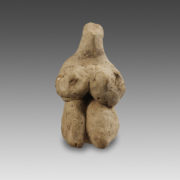
Miniature Feminine Statuette
This Near Easter Terracotta Miniature Feminine Statuette is considered as a Tell Halaf Statuette, as she features their style, typology and technique. It depicts a female figure seated with her knees bent and drawn up towards her body; her arms are wrapped around her enormous breasts.
Statuette of a Dwarf Warrior
Early Imperial Romain Bronze Statuette of a Dwarf Warrior from the 1st-2nd century A.D. The statuette, made of solid bronze, was cast using the lost-wax technique. The statuette, made of solid bronze, was cast using the lost-wax technique. It was attached to its base (of which no trace remains) by a tenon visible beneath the raised foot.
Hunchback Statuette (?)
Hand-modelled, the sculpture depicts a figure of indeterminate gender, characterised above all by the obvious deformation of its spine: its back forms a large hump, emphasised by the spine, which is slightly raised, and by the rendering of the ribs, painted dark brown. This deformity causes the figure’s torso to lean abnormally forwards and to the left.
Statue in T Symbol
Mycenaean Terracotta Statuette in T Symbol from the 14th-13th century B.C.
This statuette, the lower part of which is hollow, was modelled by hand. It
depicts a slender, graceful woman with rather abstract features. It was from the end of the 15th century BCE that figurines of this type began to appear in Mycenaean dwellings, tombs and sanctuaries.
Amulet of a standing Bes
As usual, Bes sports a grimacing, grotesque expression, which makes him appear almost hilariously amused and thus portrays him as a positive and benevolent figure: his face is flattened and viewed from the front, with a wrinkled forehead crossed by thick eyebrows, wide-open eyes, a broad, flattened nose, ears reminiscent of a feline’s, and a beard ending in large, spiraling curls.
Seated Terracotta Statuette
Like almost all Syrian terracotta statuettes dated to this period, this figurine was hand-modeled in a very stylized, almost instinctive manner; it is seated on a simplified stool.
Large Ceramic Bowl
This Western Asian Large Ceramic Bowl with painted animals is made of beige ceramic covered with a red slip; the shape is simple, trunconical and without handles; the flat circular base provides the bowl a good balance.
Near Eastern Bowl with the Figurine of a Bull
The bowl is perfectly turned. The ceramic is beige, but the surface is entirely covered with colored paint. The element that makes this piece a very special, perhaps unique object, is certainly the statuette of the quadruped.
Perfume Flask in the Shape of a Date
Vessels in the shape of dates, which look very realistic with the vertical grooves imitating the wrinkles of the dried fruit, are among the most famous and popular glass vases of the early Imperial period.
Near Eastern Conical Bowl
In the Near Eastern world, stone vases were considered luxury goods and belonged to high-ranking individuals or to the treasures of sanctuaries: they were used to store valuable materials (ointments, liquids for female toiletry for instance; but also wheat, oils, etc., given the size of the vessel), as ritual vessels for religious cults, as grave goods.
©Designed by Webgenève - Création de site internet

Rue Etienne Dumont, 9 1204 Geneva
Tel. +4122 301 9378
Email: contact@young-collectors.com