
Medieval Bronze Pendant with Enamel and Gilding
Decorated with enamel and gilding, this striking bronze pendant is an excellent example of medieval jewelry. The pendant is in a trefoil shape, each of the lobes outlined in green and red enamel. This shape was one used in the Middle Ages to represent the Christian trinity, with each of the lobes of the trefoil representing a different form of God (the father, son and Holy Spirit).
Cup with a pastoral scene
This cup is impressive, particularly because of the thickness of its walls and its weight. The vessel, made of copper cast in a mould, has no handles: its profile is truncated conical and very linear. It rests on a small, solid triangular foot.
The decoration, in very shallow relief, covers the entire available surface. Three bulls, recognisable by the shape of their horns, stand facing to the right of the viewer.
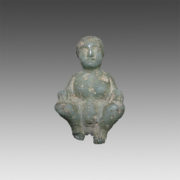
Statuette of a crouching woman
Greco-Roman molded glass statuette / amulet of a crouching woman from the 3rd century B.C. – 2nd century A.D. Complete and in good condition despite few chips and cracks.
It depicts a completely nude female figure, seen from the front and portrayed in a very distinctive pose: she is crouching, but only her feet, resting flat on the ground, touch the floor.
Statuette of a Dwarf Warrior
Early Imperial Romain Bronze Statuette of a Dwarf Warrior from the 1st-2nd century A.D. The statuette, made of solid bronze, was cast using the lost-wax technique. The statuette, made of solid bronze, was cast using the lost-wax technique. It was attached to its base (of which no trace remains) by a tenon visible beneath the raised foot.
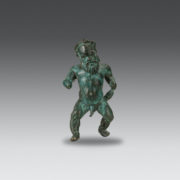
Imperial Romain Bronze Statuette of a Dwarf Silene
from the 1st-2nd century A.D.
In very good condition with superb patina even if the right hand is lost.
He is identified as Silenus by his pointed ears, snub nose, and the wavy incisions on his body, which indicate that he was once hairy. His head is crowned, and in his left hand he holds a bunch of grapes.
Twisted Bracelet
The bracelet, which, given its size, was most likely worn on the arm rather than the wrist, is made of a long, thick twisted bronze wire. Its ends, which are very close together, are flat and decorated with a series of incised vertical lines.
Statuette of a Wild Sheep or a Ram
This Statuette of a Wild Sheep or a Ram was carved from a thin stone pebble, which is still partially translucent, despite the current dark and worn appearance of the surface.
Statuette of a Human-Headed Bull
This Statuette of a Human-Headed Bull represents a very popular mythological hybrid figure that was largely widespread in Near Eastern iconography (especially in glyptics) from the Sumerian period, that is the bull with a bearded human head, wearing a headgear (tiara) adorned with a single pair of horns.
Applique in the shape of the Bust of Herakles
This bronze cast Applique in the shape of the Bust of Herakles is slightly hollow in the lower part. Given its semicircular outline, it is thought to have been part of a bed decoration (fulcrum).
Byzantine stone animal: double-headed
Carved from two fragments of dark green stone mottled with light patches (steatite probably), these two objects represent animals with highly stylized and abstract shapes.
Egyptian Anepigraphic Scarab
The scarab is placed on a flat, elliptical base; the bottom has no inscription. Characterized by stylized, though complete and accurate shapes, this beetle shows elegant features that indicate the details of the anatomy.
Amulet of a standing Bes
As usual, Bes sports a grimacing, grotesque expression, which makes him appear almost hilariously amused and thus portrays him as a positive and benevolent figure: his face is flattened and viewed from the front, with a wrinkled forehead crossed by thick eyebrows, wide-open eyes, a broad, flattened nose, ears reminiscent of a feline’s, and a beard ending in large, spiraling curls.
©Designed by Webgenève - Création de site internet

Rue Etienne Dumont, 9 1204 Geneva
Tel. +4122 301 9378
Email: contact@young-collectors.com