
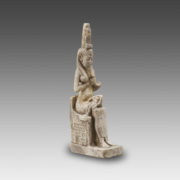
Egyptian faience Amulet representing Isis Lactans from the 7th-1st century B.C. Complete and in good condition even if Horus' head and the left hand of the goddess are lost.
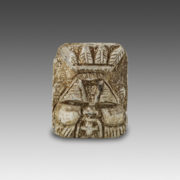
Egyptian faience amulet representing the head of Bes from the 3rd Intermediary Period. Complete and in good condition despite few chips on the crown, the mask and the ears.
This Statuette of a Wild Sheep or a Ram was carved from a thin stone pebble, which is still partially translucent, despite the current dark and worn appearance of the surface.
The Seal in the Shape of a Lion’s Head, modeled in the shape of a stylized leonine protome, was carved from a cream-colored limestone veined with red.
Carved from a small limestone monolith, this statuette is certainly one of the first three-dimensional images of elephant in Near Eastern art; moreover, these large mammals were rarely represented in the rich animal iconography of this prominent culture.
This seal, modeled in the shape of a stylized pig was carved from a cream-colored limestone.
This mask, delineated by three fringes of white, red and black beads, clearly highlights the anatomical details connected with the senses: the ears, the eyes with the black irises, the nose and the mouth made of red beads.
The figurine is flat and slightly rounded. The shield-shaped outline, typical of these idols known as “schematic”, probably represents the silhouette of a seated human body, but without any volume.
This ushabti represents a male figure with a short false beard and a rounded wig, only painted on the front part of the statuette.
©Designed by Webgenève - Création de site internet

Rue Etienne Dumont, 9 1204 Geneva
Tel. +4122 301 9378
Email: contact@young-collectors.com