
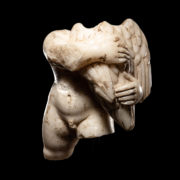
Ancient Roman Marble Cupid with a Bird
A small, statuette-size sculpture represents Cupid (Eros in Greek art) holding a big bird against his chest. The motif comes back to the Hellenistic art that introduced several charming representations of children or Erotes with their pets, little dogs or birds
Stela representing a Woman
The stele is like a large, almost rectangular slab. It depicts the bust of a woman with a somewhat stiff and impersonal expression, carved in very high relief. The base, the back and the sides are flat and roughly hewn: it is possible that it served as a funerary stele.
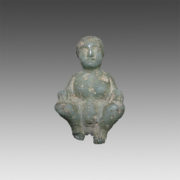
Statuette of a crouching woman
Greco-Roman molded glass statuette / amulet of a crouching woman from the 3rd century B.C. – 2nd century A.D. Complete and in good condition despite few chips and cracks.
It depicts a completely nude female figure, seen from the front and portrayed in a very distinctive pose: she is crouching, but only her feet, resting flat on the ground, touch the floor.
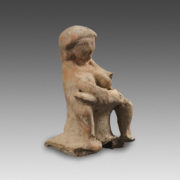
Statuette of a women breast-feeding a child
This statuette belongs to a significant series of figurines with similar characteristics originating from the Phoenician and Punic worlds. Generally dated to the 7th–6th centuries B.C., they may be standing or seated, holding a child or various attributes (musical instruments, a fan, ears of grain, etc.) or simply holding their breast or belly: in the latter case, they are often called dea gravida
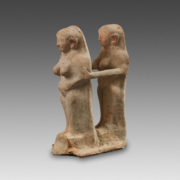
Group of two feminine statuettes
Levantine terracotta Group of two feminine statuettes from the 7th-6th century B.C. Complete and in good condition. Big chips on the basis. Concretion and few polychromy remains (brown-red).
This group belongs to a significant series of figurines with similar characteristics originating from the Phoenician and Punic worlds. Generally dated to the 7th–6th centuries B.C., they may be standing or seated, carrying a child or various attributes (musical instruments, a fan, ears of grain, brooches, etc.) or simply holding their breast or belly: in the latter case, they are often called dea gravida.
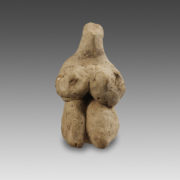
Miniature Feminine Statuette
This Near Easter Terracotta Miniature Feminine Statuette is considered as a Tell Halaf Statuette, as she features their style, typology and technique. It depicts a female figure seated with her knees bent and drawn up towards her body; her arms are wrapped around her enormous breasts.
Statuette of a Dwarf Warrior
Early Imperial Romain Bronze Statuette of a Dwarf Warrior from the 1st-2nd century A.D. The statuette, made of solid bronze, was cast using the lost-wax technique. The statuette, made of solid bronze, was cast using the lost-wax technique. It was attached to its base (of which no trace remains) by a tenon visible beneath the raised foot.
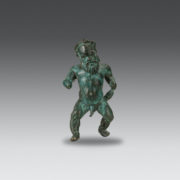
Imperial Romain Bronze Statuette of a Dwarf Silene
from the 1st-2nd century A.D.
In very good condition with superb patina even if the right hand is lost.
He is identified as Silenus by his pointed ears, snub nose, and the wavy incisions on his body, which indicate that he was once hairy. His head is crowned, and in his left hand he holds a bunch of grapes.
Hunchback Statuette (?)
Hand-modelled, the sculpture depicts a figure of indeterminate gender, characterised above all by the obvious deformation of its spine: its back forms a large hump, emphasised by the spine, which is slightly raised, and by the rendering of the ribs, painted dark brown. This deformity causes the figure’s torso to lean abnormally forwards and to the left.
Statuette of a Wild Sheep or a Ram
This Statuette of a Wild Sheep or a Ram was carved from a thin stone pebble, which is still partially translucent, despite the current dark and worn appearance of the surface.
Statuette of a Human-Headed Bull
This Statuette of a Human-Headed Bull represents a very popular mythological hybrid figure that was largely widespread in Near Eastern iconography (especially in glyptics) from the Sumerian period, that is the bull with a bearded human head, wearing a headgear (tiara) adorned with a single pair of horns.
©Designed by Webgenève - Création de site internet

Rue Etienne Dumont, 9 1204 Geneva
Tel. +4122 301 9378
Email: contact@young-collectors.com