
Ancient Attic Greek Black-Figure Lekythos
This lekythos is a tall vessel with a single handle attached to the broad shoulder terminating in a narrow neck and a rather large, semi-spherical mouth covered in black. The lower part of the body and a circular foot are also painted in black. The neck received a delicate decoration of tendrils of ivy with typical heard-shape leaves and stylized berries; it is separated from the shoulder by a band of tongues. The shoulder has a chain of seven, prominently painted palmettes.
Ancient Corinthian Greek Terracotta Lekanis with Panthers, a Sphinx, and Harpies
The lekanis has twin spurred handles on either side of a shallow footed bowl, decorated by three rows of red pomegranates along the rim and a series of red, black, and clay colored bands below
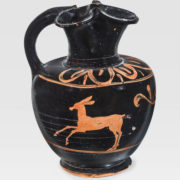
Ancient Apulian Xenon Ware Oinochoe
A trefoil oinochoe with spreading foot and cylindrical handle, The body painted with a deer and an inverted palmette flanked by scrolls, egg-and-dart on the shoulder.
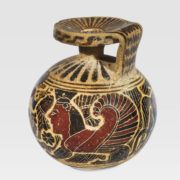
Ancient Corinthian Terracotta Aryballos with Warriors in combat
Attributed to the Warrior Group
The spherical aryballos depicts two hoplite figures in combat, flanked on one side by a seated sphinx and a horseman on the other. Rosettes and amorphous shapes decorate the remaining planes, with many details painted in red throughout. Tongues adorn the top of the rim and shoulder, zig-zags band along the handle, and a whirl with recessed center features on the underside.
Guttus with Spout and Strainer
A small drinking vessel known as a ‘guttus’. It is a small container designed to fill other vessels, such as oil lamps, via its spout located on the body (which is slender and tapered on the vase in question). As its name suggests, the liquid flowed from it only in small quantities or drop by drop.The shape, size and technique thus allow us to date the production of this vase to Magna Graecia, during the first half of the 4th century BC.
Cup with a pastoral scene
This cup is impressive, particularly because of the thickness of its walls and its weight. The vessel, made of copper cast in a mould, has no handles: its profile is truncated conical and very linear. It rests on a small, solid triangular foot.
The decoration, in very shallow relief, covers the entire available surface. Three bulls, recognisable by the shape of their horns, stand facing to the right of the viewer.
Polychrom Askos with two necks
A small but charming example of an ‘askos’ form, one of the most significant in Daunian pottery from the early Hellenistic period. Here, the usual wide neck is complemented by a second, symmetrical spout, fitted with a strainer and positioned at the rear of the body.
Pyxis with its lid
This piece is a fine example of Bactrian craftsmanship from the Hellenistic period. It forms part of the long and rich tradition of stonework and inlay that flourished in this remote region of Western Asia as early as the Early Bronze Age.
Olpe with volute handle
The olpe is made of silver sheet. Its body, shaped like a teardrop, is supported by a low, truncated conical foot; its rounded shoulder tapers into a low, flared neck. With its airy, sinuous outline, the handle lends the vessel an even more elegant shape.
Bottle with Decorations
With no handles, this richly decorated bottle has a spherical yet flattened body, supported by a small ring-shaped base. It was probably used for serving drinks, as a piece of tableware.
Skyphos with Linear Decoration
The skyphos is a vessel designed primarily for drinking wine at banquets (symposia): the term refers to a rather deep, elegantly shaped cup with two horizontal handles, which was particularly common in Corinth. It is sometimes also called a kotyle.
Oenochoe with Trilobate Spout
The shape is elegant, with a globular body supported by a circular foot with an elaborate profile, and a long cylindrical neck ending in a smooth rim. The handle is distinctive: at its end, it features a large triangular decorative element, which also provides a comfortable resting place for the thumb whilst pouring.
From the 2nd century AD onwards, the Romans tended to prefer glass vessels of a natural colour (transparent, slightly bluish or green) rather than bright hues, as had been the case at the very beginning of the Imperial period.
©Designed by Webgenève - Création de site internet

Rue Etienne Dumont, 9 1204 Geneva
Tel. +4122 301 9378
Email: contact@young-collectors.com