
Ancient Art and Antiquities For Sale

Cart

Empty Cart
  • No products in the cart.
  • My Account
    • Edit address
    • Change password
    • View order
  • English
  • Login / Register
  • HOME
  • SHOP
  • ABOUT US
  • BLOG
  • CONTACT
  • BILIANAK.
  • PHOENIX ANCIENT ART
Back to top

Statue in T Symbol

Home  / Idols / Statue in T Symbol

Statue in T Symbol

Statue in T Symbol

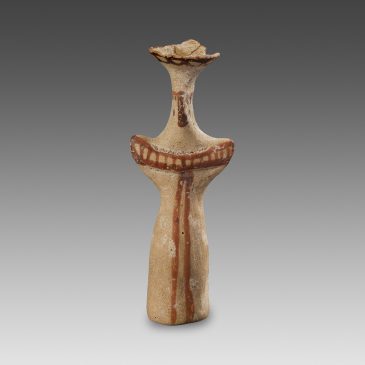
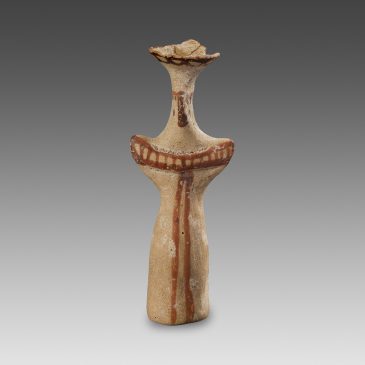
Mycenaean Terracotta Statuette in T Symbol from the 14th-13th century B.C.

This statuette, the lower part of which is hollow, was modelled by hand. It
depicts a slender, graceful woman with rather abstract features. It was from the end of the 15th century BCE that figurines of this type began to appear in Mycenaean dwellings, tombs and sanctuaries.

Mycenaean Greek art
14th - 13th century B.C.
H : 9.2 cm

In stock

In stock

Price:CHF 8'700

Categories: Idols, Sculpture.

Love it, share it!

  • Description
  • Additional information
  • Product Inquiry

Product Description

This statuette, the lower part of which is hollow, was modelled by hand. It
depicts a slender, graceful woman with rather abstract features: her legs and
feet, entirely covered by a long cylindrical dress, are hidden from view; her arms,
spread apart and raised, form a crescent shape with her torso; the slender,
pointed shape of her face was created by pinching the clay between two fingers. On her head, she wears a triangular headdress (reminiscent of a polos despite its open shape) featuring a flexible strip that runs down her back and forms a plait.

The statuette is adorned with numerous abstract and linear elements, painted in reddish-brown, which generically denote the anatomy of the face (eyes, nose, mouth, fringe) as well as the details of the garment: a loose necklace (or the decorated top of the dress?) and the wavy edge of the polos.

It was from the end of the 15th century BCE that figurines of this type began to appear in Mycenaean dwellings, tombs and sanctuaries. They are classified
according to the shape of the Greek alphabet letter they depict: statuettes in the
Tau, such as the one under consideration (the arms form a T in relation to the torso), those in Psi, with the arms raised in a gesture of epiphany, and those in Phi (with a circular body).
The precise significance of Mycenaean figurines remains unclear and, particularly given their place of origin, several hypotheses have been put forward regarding them (they have been interpreted variously as images of a deity, as votive offerings, as companions for the deceased, or even as toys). Behind their typological uniformity, these statuettes likely conceal different uses, as best evidenced by the wide variety of sites where they have been found.

Additional information

Culture

Mycenaean Greek art

Datation

14th – 13th century B.C.

Dimensions

H : 9.2 cm

Type

Sculpture

Material

Ceramic

Colors

Brown

Condition

Complete in good condition, some chips. Shine on the hat.

Serial Number

20820

Other Products

  • Details Add to cart
    ADDED

    Centered idol

    CHF 2'100 Read More
  • Bronze Figure of a Man wearing a Chlamyd
    Details Add to cart
    ADDED

    Bronze Figure of a Man wearing a Chlamyd

    Bronze Figure of a Man wearing a Chlamyd

    The statuette is made of solid bronze. It depicts a standing male figure, clad in a short cloak (which the Greeks called a chlamys) fastened over the right shoulder with a circular fibula. The man extends his right arm towards the viewer, whilst his left arm is entirely concealed beneath the cloak. In his visible hand, clenched into a fist, he held an attribute. His feet are clad in high ankle boots, fastened with incised laces. His hair, cut short, covers his head like a cap; a few strands are indicated by regular engravings. A button in the centre of the skull probably served to secure a headdress.

    CHF 9'200 Read More
  • Grotesque Mask (Mime or Aulos Player)
    Details Add to cart
    ADDED

    Grotesque Mask (Mime or Aulos Player)

    Grotesque Mask (Mime or Aulos Player)

    This face certainly represents a male figure; it shows some of the distinctive features of the Greek-Roman images known as “grotesque”, such as the big aquiline and pointed nose, the strongly marked, frowning eyebrows and the wrinkled forehead.

    CHF 6'400 Read More

Blog

Antique Idols

As soon as humans were able to think, they consistently […]

Antiquity’s Colors

English Translation Soon Les œuvres qui nous sont parvenues de […]

Glassware production

Glass, a luxury and exquisite material, whose technical virtuosity reached […]

Categories

  • Artifacts
  • Events & exhibitions
  • Facts & Figures
  • The gallery
  • FAQs
  • Terms of Use
  • Terms of Sale
  • Contact us

©Designed by Webgenève - Création de site internet


Rue Etienne Dumont, 9 1204 Geneva
Tel. +4122 301 9378
Email: contact@young-collectors.com

This website uses cookies. If you continue browsing this website, your action is considered to be a cookie policy acceptance.
