
Statuette of a crouching woman

Statuette of a crouching woman
Statuette of a crouching woman
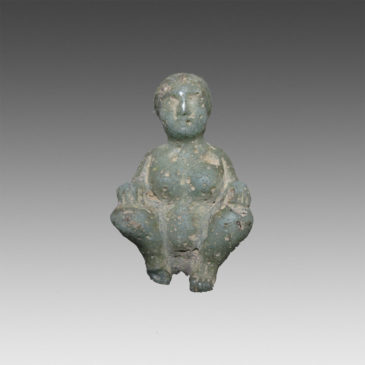
Greco-Roman molded glass statuette / amulet of a crouching woman from the 3rd century B.C. – 2nd century A.D. Complete and in good condition despite few chips and cracks.
It depicts a completely nude female figure, seen from the front and portrayed in a very distinctive pose: she is crouching, but only her feet, resting flat on the ground, touch the floor.
2nd century A.D., 3rd century B.C.
H: 3.4 cm
Product Description
This statuette was cast in an opaque light green glass, the appearance of which was undoubtedly intended to imitate the traditional colour of earthenware.
It depicts a completely nude female figure, seen from the front and portrayed in a very distinctive pose: she is crouching, but only her feet, resting flat on the ground, touch the floor. Her bent legs are partially apart, whilst she rests her hands on her knees: her genitals are thus visible to the viewer. Her exuberant sexuality is also emphasised by her ample breasts. At the same time, her prominent, well-rounded belly might suggest that the woman is pregnant and perhaps not far from giving birth.
From a stylistic point of view, it is worth highlighting the high quality of the figurine, whose distinctive pose is perfectly captured and whose forms are skilfully modelled in three dimensions. Numerous anatomical details enrich the face and the entire body.
The woman has long hair, with a fringe falling over her forehead, whilst at the back the strands are gathered into a plait that falls to the top of her shoulders, slightly offset to the left. A headband holds the hair in place on her head.
The woman has long hair, with a fringe falling over her forehead, whilst at the back the strands are gathered into a plait that falls to the top of her shoulders, slightly offset to the left. A headband holds the hair in place on her head.
This figurine belongs to a series of small objects of a generally ‘erotic’ nature, featuring numerous variations and most often originating from Egypt or the Levant; chronologically, they are generally attributed to the Hellenistic period or the early Imperial period. Modelled in terracotta, glass, metal or even earthenware, these statuettes have sometimes been linked to the myth of Demeter at Eleusis (the specific figure in question is said to be Baubo, a woman from the court of the king of Eleusis); this interpretation has now been abandoned, although in archaeological literature the name Baubo (or Pseudo-Baubo) is still sometimes used for this class of amulets. Unlike depictions of women ostentatiously exposing their genitals with a hand gesture, here, as we have seen, the image appears gentler and more akin to that of a pregnant woman.
This statuette/amulet was certainly believed to possess magical and apotropaic powers (thanks to its miniature size, it fits easily in one hand or can be carried on one’s person), and is thought to have been intended to protect a woman during pregnancy or childbirth, much like contemporary depictions of the god Bes in Egypt.


