
Ancient Art and Antiquities For Sale

Cart

Empty Cart
  • No products in the cart.
  • My Account
    • Edit address
    • Change password
    • View order
  • English
  • Login / Register
  • HOME
  • SHOP
  • ABOUT US
  • BLOG
  • CONTACT
  • BILIANAK.
  • PHOENIX ANCIENT ART
Back to top

« Token » with Flower Pattern

Home  / Jewelry / « Token » with Flower Pattern

« Token » with Flower Pattern

« Token » with Flower Pattern

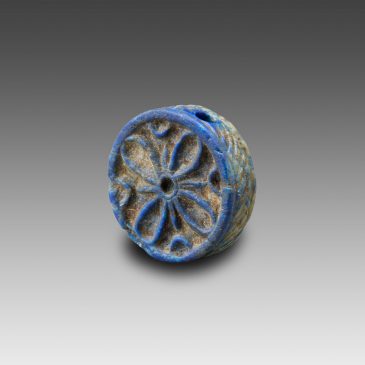
The ‘token’ (the term is chosen solely because of its shape, with no reference to its ancient use, which is currently unknown) is carved from a small lapis lazuli pebble of a beautiful azure blue, veined with grey in places.

Bactrian, Western Asiatic
3rd millenium B.C.
D : 2.8 cm

In stock

In stock

Price:CHF 5'600

Category: Jewelry. Tags: Bactrian, flower, Lapis, Lazuli, Skyphos with Linear Decoration, token, Western Asiatic.

Love it, share it!

  • Description
  • Additional information
  • Product Inquiry

Product Description

The ‘token’ (the term is chosen solely because of its shape, with no reference to its ancient use, which is currently unknown) is carved from a small lapis lazuli pebble of a beautiful azure blue, veined with grey in places. It is shaped like a small but rather thick disc (8–9 mm thick). A hole four millimetres in diameter runs through the edge. On both sides, the decoration is virtually identical (though its orientation is slightly offset): four petals, raised in relief at the edges and emerging from a central circle, form a flower. Cross-shaped lines and semicircles complete the design, whilst a frieze of slanted lines adorns the entire edge.

Only a few other similar ‘tokens’ are known: decorated with figurative scenes, they date from the second half of the third millennium BCE. Strung on a piece of string or mounted on a bronze pin (the example in the Louvre still has the remains of a pin in the hole), they may have been used as pendants or as decorative items. The fact that all these objects are engraved on both sides rules out their use as seals

The most significant lapis lazuli deposits known in antiquity are situated in the mountain ranges of present-day Afghanistan (which the Greeks and Romans called Bactria), Pakistan and Tajikistan: although a few lapis lazuli artefacts are known to date back to the Neolithic period, it was from the 4th and 3rd millennia BC onwards that this important mineral resource began to be traded regularly between the Middle and Near East, as it was exported as far afield as Iran, Mesopotamia, the Mediterranean coast and Egypt. Lapis lazuli was a highly prized semi-precious stone, used in the manufacture and decoration of luxury items (architecture, sculptures, vessels, etc.) as well as in goldsmithing.

Additional information

Culture

Bactrian, Western Asiatic

Datation

3rd millenium B.C.

Dimensions

D : 2.8 cm

Type

Gem, Seal & Intaglio, Token

Material

Lapis Lazuli

Colors

Blue

Condition

Complete and in very good condition, with minor chips.

Serial Number

16931

Other Products

  • Byzantine Reliquary Cross (Encolpion)
    Details Add to cart
    ADDED

    Byzantine Reliquary Cross (Encolpion)

    Byzantine Reliquary Cross (Encolpion)

    This cross, which can still be opened and closed, is composed of two bronze boxes that were molded and held by hinges. A thick suspension ring enabled the encolpion to be worn as a pendant.

    CHF 6'000 Read More
  • Greek Silver Phiale
    Details Add to cart
    ADDED

    Silver Phiale with Repousse Decoration

    Silver Phiale with Repousse Decoration

    A medium-sized, perfectly circular phiale, with a low wall. The body is hollow with a very flared rim; it was hammered from a single, thin sheet of silver. The decoration was entirely carried out in repoussé work, chased from inside and/or outside: it is composed of a central medallion (the omphalos) surrounded by a stem of half-moons alternately surmounted by five lotus flowers and five ovolo patterns.

    CHF 26'000 Read More
  • Chalice with Geometrical Decoration
    Details Add to cart
    ADDED

    Large Chalice with Geometrical Decoration

    Large Chalice with Geometrical Decoration

    This vessel, the size of which makes it one of the largest examples currently known, attracts the eye of the modern viewer with its formal and decorative simplicity. It belongs to a group of well-attested ceramics in the so-called Chalcolithic period (the period that precedes the widespread use of metals, particularly copper and, later, bronze), on the sites of modern-day northern Iran.

    CHF 13'000 Read More

Blog

Antique Idols

As soon as humans were able to think, they consistently […]

Antiquity’s Colors

English Translation Soon Les œuvres qui nous sont parvenues de […]

Glassware production

Glass, a luxury and exquisite material, whose technical virtuosity reached […]

Categories

  • Artifacts
  • Events & exhibitions
  • Facts & Figures
  • The gallery
  • FAQs
  • Terms of Use
  • Terms of Sale
  • Contact us

©Designed by Webgenève - Création de site internet


Rue Etienne Dumont, 9 1204 Geneva
Tel. +4122 301 9378
Email: contact@young-collectors.com

This website uses cookies. If you continue browsing this website, your action is considered to be a cookie policy acceptance.
