
Ancient Art and Antiquities For Sale

Cart

View Cart
  • No products in the cart.
  • My Account
    • Edit address
    • Change password
    • View order
  • English
  • Login / Register
  • HOME
  • SHOP
  • ABOUT US
  • BLOG
  • CONTACT
  • BILIANAK.
  • PHOENIX ANCIENT ART
Back to top

Egyptian faience ushabti of Queen Henuttawy

Home  / Sculpture / Ushabti / Egyptian faience ushabti of Queen Henuttawy
View cart “Byzantine stone animal: double-headed” has been added to your cart.

Egyptian faience ushabti of Queen Henuttawy
Egyptian faience ushabti of Queen Henuttawy
Egyptian, Third Intermediate Period, 21st Dynasty, ca. 1000 B.C.

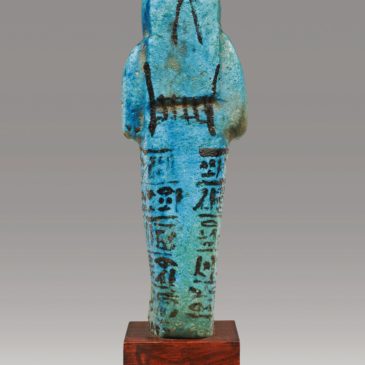
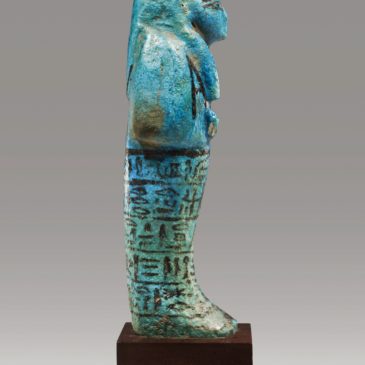
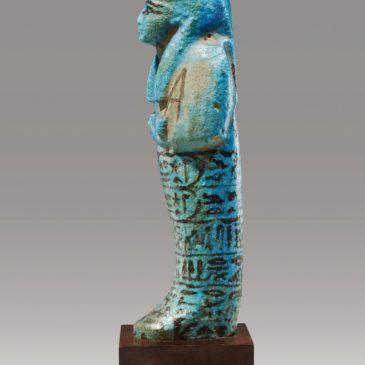
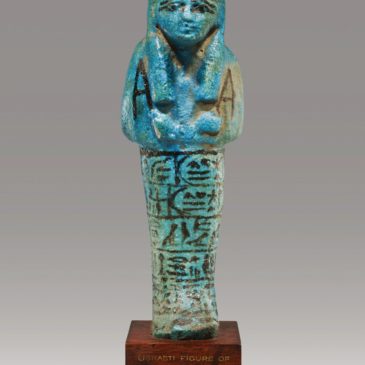
Depicted mummiform, bright blue in color, with details in black, including the eyes and brows, a fillet in her hair and a hoe in each of her fisted hands, with six rows of hieroglyphs, reading: “Instructions of the Osiris, the Divine Adoratress Henut-tawy, She says: ‘O these shabty!” and continuing with a form of the standard shabti text from Chapter 6 of The Book of the Dead.


Egyptian
21st Dynasty, Around 1000 BC, Third Intermediate Period
H: 15 cm

Price:CHF 35'000

Categories: Ushabti, Sculpture. Tags: Blue, Egypt, egyptian, Ushabti.

Love it, share it!

  • Description
  • Additional information
  • Product Inquiry

Product Description

This ushabti belongs to the adoratrice Henuttawy, daughter of Pinodjem I and his wife Queen Henuttawy (same name as her daughter), and sister of Maatkare.

The Divine Adoratrice was a prestigious title initially given to royal women in order to facilitate the transfer of power from one pharaoh to the next. During the days of Theban theocracy, instead, this office served for the dynastic succession of the high priest of Amun. As a high priestess and earthly spouse of the god Amun, the Divine Adoratrice also ruled over the extensive temple duties and domains, controlling an important part of the ancient Egyptian economy.

The significance of the office is attested by the fact that Henuttawy’s name and title are written inside a royal cartouche.

Henuttawy may have held her office until the accession to power of the Lybians around 940 BC. Sheshonq I (ca. 943-922 BC) terminated the hereditary succession of the high priesthood of Amun at Thebes.

Henuttawy’s existence is only known from her shabtis, which first appeared around 1845. According to Aubert they were possibly found in a 22nd Dynasty cemetery within the Ramesseum, the mortuary temple of Ramses II.

Depicted mummiform, bright blue in color, with details in black, including the eyes and brows, a fillet in her hair and a hoe in each of her fisted hands, with six rows of hieroglyphs, reading: “Instructions of the Osiris, the Divine Adoratress Henut-tawy, She says: ‘O these shabty!” and continuing with a form of the standard shabti text from Chapter 6 of The Book of the Dead.

PROVENANCE: First cache, Deir el Bahri, Egypt, 1881 (according to the inscribed base); Ex – Joel L. Malter collection, Encino, California, 1979; Ex- US private collection.

Additional information

Culture

Egyptian

Datation

21st Dynasty, Around 1000 BC, Third Intermediate Period

Dimensions

H: 15 cm

Type

Ushabti

Material

Faience

Colors

Black, Blue, Turquoise

Condition

In very good condition.

Serial Number

28491

Other Products

  • Bronze Figure of a Man wearing a Chlamyd
    Details Add to cart
    ADDED

    Bronze Figure of a Man wearing a Chlamyd

    Bronze Figure of a Man wearing a Chlamyd

    The statuette is made of solid bronze. It depicts a standing male figure, clad in a short cloak (which the Greeks called a chlamys) fastened over the right shoulder with a circular fibula. The man extends his right arm towards the viewer, whilst his left arm is entirely concealed beneath the cloak. In his visible hand, clenched into a fist, he held an attribute. His feet are clad in high ankle boots, fastened with incised laces. His hair, cut short, covers his head like a cap; a few strands are indicated by regular engravings. A button in the centre of the skull probably served to secure a headdress.

    CHF 9'200 Read More
  • Shield-Shaped Anatolian Idol
    Details Add to cart
    ADDED

    Shield-Shaped Anatolian Idol

    Shield-Shaped Anatolian Idol

    The figurine is flat and slightly rounded. The shield-shaped outline, typical of these idols known as “schematic”, probably represents the silhouette of a seated human body,  but without any volume.

    CHF 3'000 Read More
  • Roman Marble Relief representing the 'Thracian Horseman'
    Details Add to cart
    ADDED

    Roman Marble Relief representing the “Thracian Horseman”

    Roman Marble Relief representing the “Thracian Horseman”

    Roman Marble Relief representing the “Thracian Horseman”. The detailed image shows a horse mounted by a young hunter who hits a boar with his spear.

    CHF 7'000 Read More

Blog

Antique Idols

As soon as humans were able to think, they consistently […]

Antiquity’s Colors

English Translation Soon Les œuvres qui nous sont parvenues de […]

Glassware production

Glass, a luxury and exquisite material, whose technical virtuosity reached […]

Categories

  • Artifacts
  • Events & exhibitions
  • Facts & Figures
  • The gallery
  • FAQs
  • Terms of Use
  • Terms of Sale
  • Contact us

©Designed by Webgenève - Création de site internet


Rue Etienne Dumont, 9 1204 Geneva
Tel. +4122 301 9378
Email: contact@young-collectors.com

This website uses cookies. If you continue browsing this website, your action is considered to be a cookie policy acceptance.
