
Ancient Art and Antiquities For Sale

Cart

View Cart
  • No products in the cart.
  • My Account
    • Edit address
    • Change password
    • View order
  • English
  • Login / Register
  • HOME
  • SHOP
  • ABOUT US
  • BLOG
  • CONTACT
  • BILIANAK.
  • PHOENIX ANCIENT ART
Back to top

Egyptian faience ushabti of Queen Henuttawy

Home  / Sculpture / Ushabti / Egyptian faience ushabti of Queen Henuttawy
View cart “Hunchback Statuette (?)” has been added to your cart.

Egyptian faience ushabti of Queen Henuttawy
Egyptian faience ushabti of Queen Henuttawy
Egyptian, Third Intermediate Period, 21st Dynasty, ca. 1000 B.C.

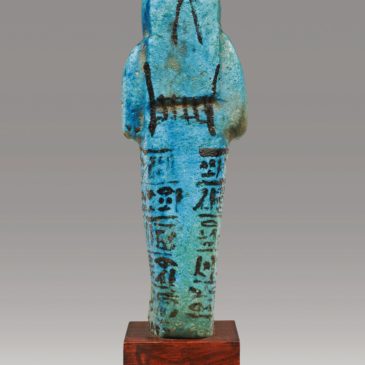
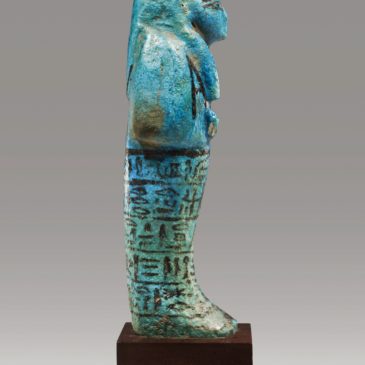
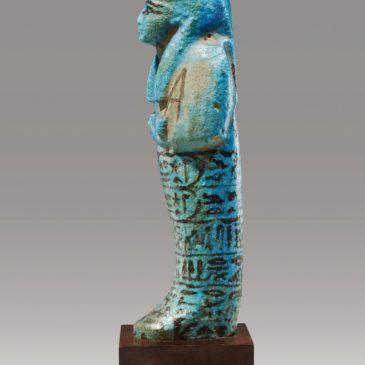
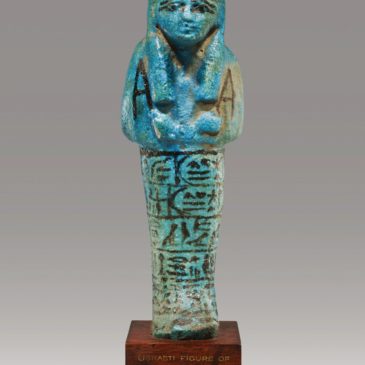
Depicted mummiform, bright blue in color, with details in black, including the eyes and brows, a fillet in her hair and a hoe in each of her fisted hands, with six rows of hieroglyphs, reading: “Instructions of the Osiris, the Divine Adoratress Henut-tawy, She says: ‘O these shabty!” and continuing with a form of the standard shabti text from Chapter 6 of The Book of the Dead.


Egyptian
21st Dynasty, Around 1000 BC, Third Intermediate Period
H: 15 cm

Price:CHF 35'000

Categories: Ushabti, Sculpture. Tags: Blue, Egypt, egyptian, Ushabti.

Love it, share it!

  • Description
  • Additional information
  • Product Inquiry

Product Description

This ushabti belongs to the adoratrice Henuttawy, daughter of Pinodjem I and his wife Queen Henuttawy (same name as her daughter), and sister of Maatkare.

The Divine Adoratrice was a prestigious title initially given to royal women in order to facilitate the transfer of power from one pharaoh to the next. During the days of Theban theocracy, instead, this office served for the dynastic succession of the high priest of Amun. As a high priestess and earthly spouse of the god Amun, the Divine Adoratrice also ruled over the extensive temple duties and domains, controlling an important part of the ancient Egyptian economy.

The significance of the office is attested by the fact that Henuttawy’s name and title are written inside a royal cartouche.

Henuttawy may have held her office until the accession to power of the Lybians around 940 BC. Sheshonq I (ca. 943-922 BC) terminated the hereditary succession of the high priesthood of Amun at Thebes.

Henuttawy’s existence is only known from her shabtis, which first appeared around 1845. According to Aubert they were possibly found in a 22nd Dynasty cemetery within the Ramesseum, the mortuary temple of Ramses II.

Depicted mummiform, bright blue in color, with details in black, including the eyes and brows, a fillet in her hair and a hoe in each of her fisted hands, with six rows of hieroglyphs, reading: “Instructions of the Osiris, the Divine Adoratress Henut-tawy, She says: ‘O these shabty!” and continuing with a form of the standard shabti text from Chapter 6 of The Book of the Dead.

PROVENANCE: First cache, Deir el Bahri, Egypt, 1881 (according to the inscribed base); Ex – Joel L. Malter collection, Encino, California, 1979; Ex- US private collection.
Additional information

Culture

Egyptian

Datation

21st Dynasty, Around 1000 BC, Third Intermediate Period

Dimensions

H: 15 cm

Type

Ushabti

Material

Faience

Colors

Black, Blue, Turquoise

Condition

In very good condition.

Serial Number

28491

Other Products

  • Details Add to cart
    ADDED

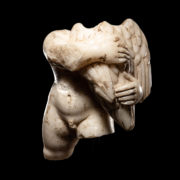
    Ancient Roman Marble Cupid with a Bird

    Ancient Roman Marble Cupid with a Bird

    A small, statuette-size sculpture represents Cupid (Eros in Greek art) holding a big bird against his chest. The motif comes back to the Hellenistic art that introduced several charming representations of children or Erotes with their pets, little dogs or birds

    CHF 25'000 Read More
  • Seal in the shape of a Pig
    Details Add to cart
    ADDED

    Seal in the shape of a Pig

    Seal in the shape of a Pig

    This seal, modeled in the shape of a stylized pig (the head is complete, but the body is a simple half-circle), was carved from a cream-colored limestone; it is pierced by a hole and was therefore intended to be worn as a pendant (necklace or bracelet).

    CHF 6'000 Read More
  • Greek terracotta figure showing the myth of Europe
    Details Add to cart
    ADDED

    Greek terracotta figure showing the myth of Europe

    Greek terracotta figure showing the myth of Europe

    The group comprises two figures: with natural grace, a young woman rides astride a bull that is galloping rapidly towards the viewer’s right. Indeed, the young woman is Europa (the mythological figure after whom our continent is named), who was one of the three daughters of the King of Tyre (a major Phoenician coastal city). She was abducted by Zeus on the beach where she was playing with her sisters: the god appeared to her in the form of a magnificent white bull and carried her, riding the waves of the sea, all the way to Crete.

    CHF 8'500 Read More

Blog

Antique Idols

As soon as humans were able to think, they consistently […]

Antiquity’s Colors

English Translation Soon Les œuvres qui nous sont parvenues de […]

Glassware production

Glass, a luxury and exquisite material, whose technical virtuosity reached […]

Categories

  • Artifacts
  • Events & exhibitions
  • Facts & Figures
  • The gallery
  • FAQs
  • Terms of Use
  • Terms of Sale
  • Contact us

©Designed by Webgenève - Création de site internet


Rue Etienne Dumont, 9 1204 Geneva
Tel. +4122 301 9378
Email: contact@young-collectors.com

This website uses cookies. If you continue browsing this website, your action is considered to be a cookie policy acceptance.
