
Ancient Art and Antiquities For Sale

Cart

View Cart
  • No products in the cart.
  • My Account
    • Edit address
    • Change password
    • View order
  • English
  • Login / Register
  • HOME
  • SHOP
  • ABOUT US
  • BLOG
  • CONTACT
  • BILIANAK.
  • PHOENIX ANCIENT ART
Back to top

Female Figure with Clasped Hands

Home  / Sculpture / Female Figure with Clasped Hands
View cart “Seated Statuette” has been added to your cart.

Female Figure with Clasped Hands

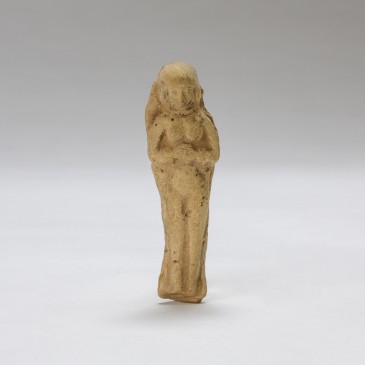
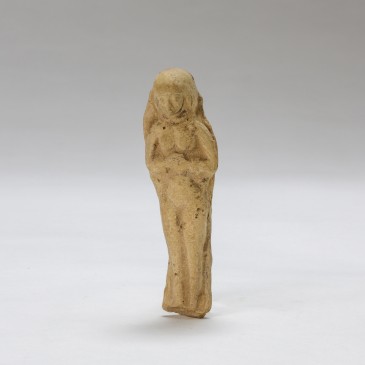
This terracotta image in relief represents a standing, richly adorned nude woman: large necklace and bracelets on the wrists.

Near Eastern
19th century B.C., 2nd millenium B.C.
H: 9.4 cm

Out of stock

Category: Sculpture.

Love it, share it!

  • Description
  • Additional information
  • Product Inquiry

Product Description

This terracotta image in relief represents a standing, richly adorned nude woman: large necklace and bracelets on the wrists.

Less accentuated than on other Near Eastern terracotta examples, the sexual connotation is nevertheless still present, as attested by the nudity of the woman, by her abundant, rounded breast and by her clearly indicated pubic triangle. Her forearms are clasped on her belly, and her hands with incised details are simply crossed. This gesture is a distinctive feature of a minor, although well-known deity of the Mesopotamian pantheon, the goddess known as Lama: this figure played an important protective role (a sort of guardian angel) and was an intermediary between the devotee (the owner of the image that she protected) and a higher divinity before whom her intercession or reconciliation was requested.

This popular art form (these terracotta plaques were mass-produced and made of stamped clay, the posterior part was flat and undecorated) appeared in the Near East around the late 3rd millennium B.C. and reached its peak during the following centuries. These small reliefs feature a large range of subjects, including religious and official scenes, secular scenes that were related to the everyday lives of the believers (professional, erotic, musical scenes, etc.). The molds circulated from city to city and served several times, which might explain their uneven quality, even when the subject is similar. They were used as ex-votos for offerings and are therefore a valuable evidence of the popular religious devotion.

Additional information

Culture

Near Eastern

Datation

19th century B.C., 2nd millenium B.C.

Dimensions

H: 9.4 cm

Type

Sculpture

Material

Terracotta

Colors

Beige

Condition

Except for a fragment in the posterior part and for the feet, now broken, the image is complete and in good condition; chips.

Serial Number

28951

Other Products

  • Miniature Feminine Statuette-5660
    Details Add to cart
    ADDED

    Miniature Feminine Statuette

    Miniature Feminine Statuette

    This Near Easter Terracotta Miniature Feminine Statuette is considered as a Tell Halaf Statuette, as she features their style, typology and technique. It depicts a female figure seated with her knees bent and drawn up towards her body; her arms are wrapped around her enormous breasts.

    CHF 2'500 Read More
  • Greek Terracotta Statuette of a Standing Actor
    Details Add to cart
    ADDED

    Greek Terracotta Statuette of a Standing Actor

    Greek Terracotta Statuette of a Standing Actor

    The statuette depicts a standing man, with a mask, which characterizes him as an actor. He is dressed in a large cloak. As it is usually the case at that time for terracotta examples, our figurine was molded in two parts, the front and the back.

    CHF 14'500 Read More
  • Grotesque Terracotta Head (Mime or Actor)
    Details Add to cart
    ADDED

    Grotesque Terracotta Head (perhaps a Mime or an Actor)

    Grotesque Terracotta Head (perhaps a Mime or an Actor)

    The statuettes of “grotesques” often represented mimes, street actors, music players, dancers, or even street vendors or workers suffering from physical deformities or afflictions that the sculptors treated in an exaggerated manner, to create a caricature-like effect. At the end of the Hellenistic period, in the large urban centers such as Rome and Alexandria, the theatrical genre of pantomime (according to tradition, this genre was created by Sophron of Syracuse in the 5th century B.C. already) was very popular.

    CHF 8'200 Read More

Blog

Antique Idols

As soon as humans were able to think, they consistently […]

Antiquity’s Colors

English Translation Soon Les œuvres qui nous sont parvenues de […]

Glassware production

Glass, a luxury and exquisite material, whose technical virtuosity reached […]

Categories

  • Artifacts
  • Events & exhibitions
  • Facts & Figures
  • The gallery
  • FAQs
  • Terms of Use
  • Terms of Sale
  • Contact us

©Designed by Webgenève - Création de site internet


Rue Etienne Dumont, 9 1204 Geneva
Tel. +4122 301 9378
Email: contact@young-collectors.com

This website uses cookies. If you continue browsing this website, your action is considered to be a cookie policy acceptance.
