
Ancient Attic Greek Black-Figure Lekythos
This lekythos is a tall vessel with a single handle attached to the broad shoulder terminating in a narrow neck and a rather large, semi-spherical mouth covered in black. The lower part of the body and a circular foot are also painted in black. The neck received a delicate decoration of tendrils of ivy with typical heard-shape leaves and stylized berries; it is separated from the shoulder by a band of tongues. The shoulder has a chain of seven, prominently painted palmettes.
Ancient Corinthian Greek Terracotta Lekanis with Panthers, a Sphinx, and Harpies
The lekanis has twin spurred handles on either side of a shallow footed bowl, decorated by three rows of red pomegranates along the rim and a series of red, black, and clay colored bands below
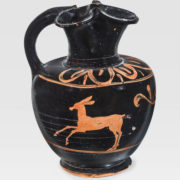
Ancient Apulian Xenon Ware Oinochoe
A trefoil oinochoe with spreading foot and cylindrical handle, The body painted with a deer and an inverted palmette flanked by scrolls, egg-and-dart on the shoulder.
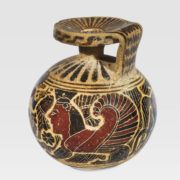
Ancient Corinthian Terracotta Aryballos with Warriors in combat
Attributed to the Warrior Group
The spherical aryballos depicts two hoplite figures in combat, flanked on one side by a seated sphinx and a horseman on the other. Rosettes and amorphous shapes decorate the remaining planes, with many details painted in red throughout. Tongues adorn the top of the rim and shoulder, zig-zags band along the handle, and a whirl with recessed center features on the underside.
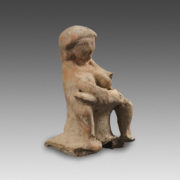
Statuette of a women breast-feeding a child
This statuette belongs to a significant series of figurines with similar characteristics originating from the Phoenician and Punic worlds. Generally dated to the 7th–6th centuries B.C., they may be standing or seated, holding a child or various attributes (musical instruments, a fan, ears of grain, etc.) or simply holding their breast or belly: in the latter case, they are often called dea gravida
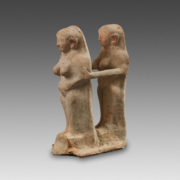
Group of two feminine statuettes
Levantine terracotta Group of two feminine statuettes from the 7th-6th century B.C. Complete and in good condition. Big chips on the basis. Concretion and few polychromy remains (brown-red).
This group belongs to a significant series of figurines with similar characteristics originating from the Phoenician and Punic worlds. Generally dated to the 7th–6th centuries B.C., they may be standing or seated, carrying a child or various attributes (musical instruments, a fan, ears of grain, brooches, etc.) or simply holding their breast or belly: in the latter case, they are often called dea gravida.
Miniature Feminine Statuette
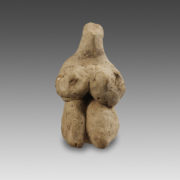
This Near Easter Terracotta Miniature Feminine Statuette is considered as a Tell Halaf Statuette, as she features their style, typology and technique. It depicts a female figure seated with her knees bent and drawn up towards her body; her arms are wrapped around her enormous breasts.
Hunchback Statuette (?)
Hand-modelled, the sculpture depicts a figure of indeterminate gender, characterised above all by the obvious deformation of its spine: its back forms a large hump, emphasised by the spine, which is slightly raised, and by the rendering of the ribs, painted dark brown. This deformity causes the figure’s torso to lean abnormally forwards and to the left.
Polychrom Askos with two necks
A small but charming example of an ‘askos’ form, one of the most significant in Daunian pottery from the early Hellenistic period. Here, the usual wide neck is complemented by a second, symmetrical spout, fitted with a strainer and positioned at the rear of the body.
Byzantine Terracotta Oil lamp
The shape, style and decoration of this example are typical of lamps produced during the final centuries of the Empire and the early Byzantine period: the most active workshops were located in North African cities, but their
products were often imitated elsewhere, notably in Italy and Gaul.
Islamic Vessel with Floral Decoration
The vessel, wheel-thrown, is made of light grey-beige clay covered with a white engobe. The decoration appears to be painted in black beneath a magnificent turquoise glaze, which is slightly thicker on the base where it has partially built up.
The technique, form and decoration are characteristic of the highly glossy ceramics produced in the workshops of the city of Kashan, situated in the centre of present-day Iran.
Greek terracotta figure showing the myth of Europe
The group comprises two figures: with natural grace, a young woman rides astride a bull that is galloping rapidly towards the viewer’s right. Indeed, the young woman is Europa (the mythological figure after whom our continent is named), who was one of the three daughters of the King of Tyre (a major Phoenician coastal city). She was abducted by Zeus on the beach where she was playing with her sisters: the god appeared to her in the form of a magnificent white bull and carried her, riding the waves of the sea, all the way to Crete.
©Designed by Webgenève - Création de site internet

Rue Etienne Dumont, 9 1204 Geneva
Tel. +4122 301 9378
Email: contact@young-collectors.com