
Islamic Vessel with Floral Decoration

Islamic Vessel with Floral Decoration
Islamic Vessel with Floral Decoration
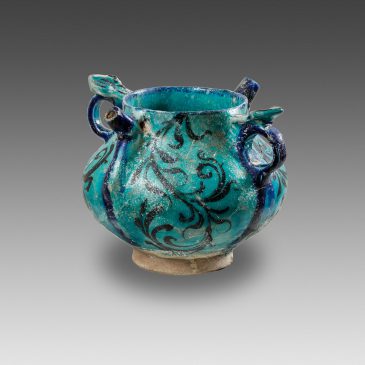
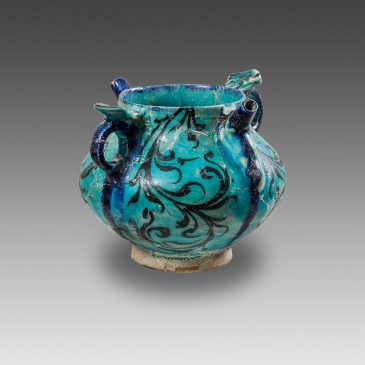
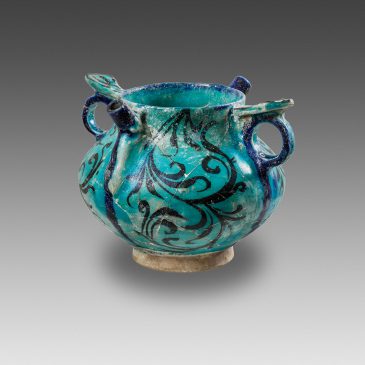
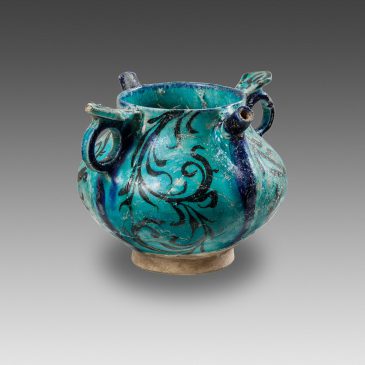
The vessel, wheel-thrown, is made of light grey-beige clay covered with a white engobe. The decoration appears to be painted in black beneath a magnificent turquoise glaze, which is slightly thicker on the base where it has partially built up.
The technique, form and decoration are characteristic of the highly glossy ceramics produced in the workshops of the city of Kashan, situated in the centre of present-day Iran.
13th century A.D.
D : 12.4 cm
In stock
Product Description
The vessel, wheel-thrown, is made of light grey-beige clay covered with a white engobe. The decoration appears to be painted in black beneath a magnificent turquoise glaze, which is slightly thicker on the base where it has partially built up.
The shape is distinctive: it is a small jar supported by a ring-shaped base and fitted with two circular handles arranged vertically; above each handle, a small triangular surface allows for a better grip on the vessel, even with just one hand. The contents could be poured out easily and with good control thanks to two narrow, cylindrical spouts positioned perpendicular to the handles.
The technique, form and decoration are characteristic of the highly glossy ceramics produced in the workshops of the city of Kashan, situated in the centre of present-day Iran.
The colours turquoise, dark blue and black used here are undoubtedly elements that continue to contribute to the success of this type of pottery to this day. Dark blue lines divide the outer surface into four sections, each adorned with a large scroll of leaves and flowers: the airy, elegant motifs are hand-drawn and are similar but not identical.
The technique used (known as metallic lustre) involves two distinct firing stages: the first to fire the clay body and the second to produce the glossy glaze. Although there is still no consensus on its origin and history, it is thought that this technique was probably invented in Iraq between the 8th and 9th centuries AD; widely used by potters in Cairo during the Fatimid Dynasty (10th and 11th centuries AD), it appeared in the Syrian world in the 12th century. In Iran, it was not until the final decades of the 12th century that the production of lustre ware began: very quickly, the city of Kashan established itself as the main centre of production where, as evidenced by the legible signatures on numerous vessels, entire dynasties of potters worked. This technique remained in vogue until the 19th century AD.


