Stela representing a Woman

Stela representing a Woman
Stela representing a Woman
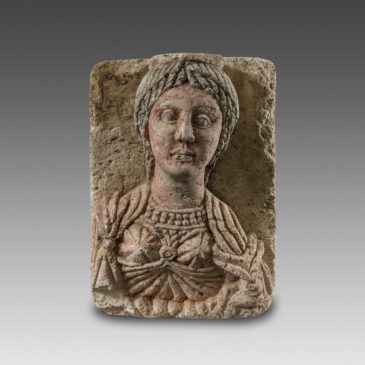
The stele is like a large, almost rectangular slab. It depicts the bust of a woman with a somewhat stiff and impersonal expression, carved in very high relief. The base, the back and the sides are flat and roughly hewn: it is possible that it served as a funerary stele.
3rd century A.D., 4th century A.D.
Dim : 26 x 19 cm
In stock
Product Description
The stele is like a large, almost rectangular slab. It depicts the bust of a woman with a somewhat stiff and impersonal expression, carved in very high relief. The base, the back and the sides are flat and roughly hewn: it is possible that it served as a funerary stele, perhaps placed as a ‘lid’ over a niche or a loculus.
The woman is dressed in a tunic, which emphasises the well-rounded contours of her bust, and a cloak draped over her shoulders, from where it falls down over her arms. Significant traces of polychromy (black-red and traces of blue) are visible on her face, clothing and hair.
Egyptian stelae and statues, probably found at the site of Oxyrhynchus (now Benhasa), provide the best parallels for the style characteristic of this image. These are mostly funerary works depicting men, women or children (stelae in high relief, statues) about which little is yet known, and whose chronology is even the subject of debate: the current view tends towards a later dating, between the 3rd and 4th centuries AD, rather than the Coptic period previously suggested: indeed, these figures, which lack attributes associated with Christian iconography, generally hold or carry objects still linked to ‘classical’ cults (Isis, for example).
Despite a certain naivety in the craftsmanship, typical of Egyptian sculptures from this region of Egypt, the woman depicted on this stele certainly belonged to the contemporary high nobility, as evidenced by the richness of her finely pleated garments and the abundance of her jewellery, comprising a large necklace with two rows of beads and several brooches; likewise, her hairstyle, arranged in small curls and spiralled locks, is befitting of a high-ranking figure.