Miniature Feminine Statuette

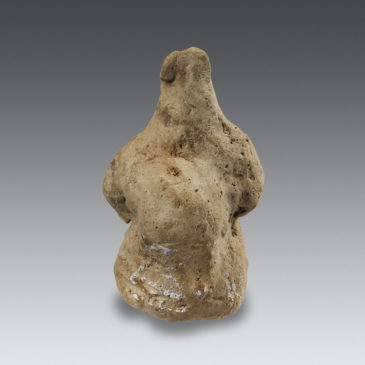
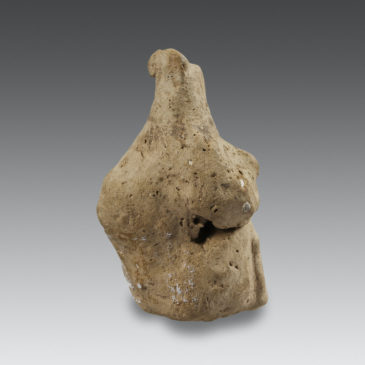
Miniature Feminine Statuette
Miniature Feminine Statuette
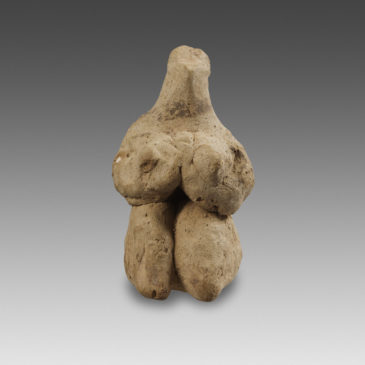
This Near Easter Terracotta Miniature Feminine Statuette is considered as a Tell Halaf Statuette, as she features their style, typology and technique. It depicts a female figure seated with her knees bent and drawn up towards her body; her arms are wrapped around her enormous breasts.
5th millenium B.C., 7th millenium B.C.
H : 3.4 cm
Product Description
Hand-modelled, this figurine is so small that it can be regarded as a miniature variant of the so-called ‘idols’ of Tell Halaf, whose technique, typology and style it echoes.
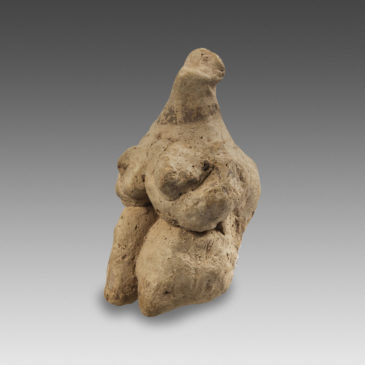
It depicts a female figure seated with her knees bent and drawn up towards her body; her arms are wrapped around her enormous breasts. The head and face are rendered simply by pinching the clay between the fingers, with a vertical semi-circular element at the back which may represent a headdress. A few painted lines, which have left traces around the neck, could indicate jewellery.
On the back, the statuette has a distinctive feature that makes it almost unique: a large, rounded and even bulge moulded above the spine and ribs, which are therefore not visible. Unfortunately, it is no longer possible to explain the significance of this bulge: could it, for example, be a depiction of an illness caused by a bone deformity?
The so-called Halaf culture originated in the northern regions of Mesopotamia (present-day northern Syria and eastern Anatolia) and is chiefly characterised by the production of high-quality painted pottery, rich in forms and natural or linear decorative motifs.
The prevalence of images of voluptuous women is a clear indication of the importance that the agro-pastoral communities of the time attached to fertility and fruitfulness as principles of survival. Established before the advent of agriculture and the development of urbanisation, this symbolism of the woman – associated with its male counterpart, the bull – would spread throughout the Near East and the Mediterranean.