
Ancient Art and Antiquities For Sale

Cart

View Cart
  • No products in the cart.
  • My Account
    • Edit address
    • Change password
    • View order
  • English
  • Login / Register
  • HOME
  • SHOP
  • ABOUT US
  • BLOG
  • CONTACT
  • BILIANAK.
  • PHOENIX ANCIENT ART
Back to top

Terracotta Canaanite lamp

Home  / Vessels / Lamps / Terracotta Canaanite lamp

View cart “Large Ceramic Bowl” has been added to your cart.

Terracotta Canaanite lamp

Terracotta Canaanite lamp

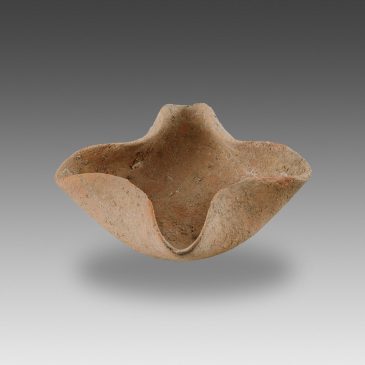
The lamp was shaped simply by folding up the rim of a circular plate – which had previously been turned on a potter’s wheel (the traces of the turning are clearly visible, especially on the rim) – at four evenly spaced points: viewed from above, the lamp thus displays an attractive design reminiscent of a four-petalled flower. The wide, round base provides the lamp with optimum stability, meaning it is unlikely to be knocked over.

Canaanite, Near Eastern
2nd millenium B.C.
D : 15.4 cm

In stock

In stock

Price:CHF 400

Category: Lamps. Tags: Canaanite, lamp, Near Eastern, terracotta.

Love it, share it!

  • Description
  • Additional information
  • Product Inquiry

Product Description

This Canaanite lamp was shaped simply by folding up the rim of a circular plate – which had previously been turned on a potter’s wheel (the traces of the turning are clearly visible, especially on the rim) – at four evenly spaced points: viewed from above, the lamp thus displays an attractive design reminiscent of a four-petalled flower. The wide, round base provides the lamp with optimum stability, meaning it is unlikely to be knocked over.

The absence of burn marks suggests that it was never used.
This is a very simple yet attractive lamp form, originally widespread in the eastern Mediterranean, particularly in the Levant (Israel, Palestine): it first appeared towards the end of the third millennium and persisted throughout the following millennium without significant variation. It is noticeable, however, that the shape shows a clear tendency to become shorter and less bulbous and, above all, that the wick openings—here rather open and rounded—evolve into proper spouts, narrow and elongated, no doubt to hold the wick more securely and minimise risks.

From the later phases of the Bronze Age onwards, the Phoenicians exported lamps with pinched spouts (usually fitted with one or two spouts) throughout the ancient world, as far as their Iberian colonies.
Additional information

Culture

Canaanite, Near Eastern

Datation

2nd millenium B.C.

Dimensions

D : 15.4 cm

Type

Lamps

Material

Ceramic

Colors

Orange

Condition

Complete and in good condition; a few chips and deposits.

Serial Number

32071

Other Products

  • Details Add to cart
    ADDED

    Statuette of a women breast-feeding a child

    Statuette of a women breast-feeding a child

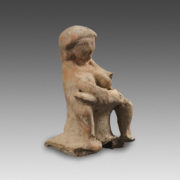
    This statuette belongs to a significant series of figurines with similar characteristics originating from the Phoenician and Punic worlds. Generally dated to the 7th–6th centuries B.C., they may be standing or seated, holding a child or various attributes (musical instruments, a fan, ears of grain, etc.) or simply holding their breast or belly: in the latter case, they are often called dea gravida

    CHF 8'200 Read More
  • Hunchback Statuette
    Details Add to cart
    ADDED

    Hunchback Statuette (?)

    Hunchback Statuette (?)

    Hand-modelled, the sculpture depicts a figure of indeterminate gender, characterised above all by the obvious deformation of its spine: its back forms a large hump, emphasised by the spine, which is slightly raised, and by the rendering of the ribs, painted dark brown. This deformity causes the figure’s torso to lean abnormally forwards and to the left.

    CHF 3'200 Read More
  • Greek terracotta figure showing the myth of Europe
    Details Add to cart
    ADDED

    Greek terracotta figure showing the myth of Europe

    Greek terracotta figure showing the myth of Europe

    The group comprises two figures: with natural grace, a young woman rides astride a bull that is galloping rapidly towards the viewer’s right. Indeed, the young woman is Europa (the mythological figure after whom our continent is named), who was one of the three daughters of the King of Tyre (a major Phoenician coastal city). She was abducted by Zeus on the beach where she was playing with her sisters: the god appeared to her in the form of a magnificent white bull and carried her, riding the waves of the sea, all the way to Crete.

    CHF 8'500 Read More

Blog

Antique Idols

As soon as humans were able to think, they consistently […]

Antiquity’s Colors

English Translation Soon Les œuvres qui nous sont parvenues de […]

Glassware production

Glass, a luxury and exquisite material, whose technical virtuosity reached […]

Categories

  • Artifacts
  • Events & exhibitions
  • Facts & Figures
  • The gallery
  • FAQs
  • Terms of Use
  • Terms of Sale
  • Contact us

©Designed by Webgenève - Création de site internet


Rue Etienne Dumont, 9 1204 Geneva
Tel. +4122 301 9378
Email: contact@young-collectors.com

This website uses cookies. If you continue browsing this website, your action is considered to be a cookie policy acceptance.
