
Near Eastern Small Stone Jar

Near Eastern Small Stone Jar
Neolithic Near Eastern Small Stone Jar
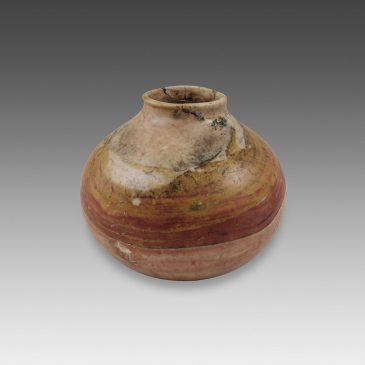
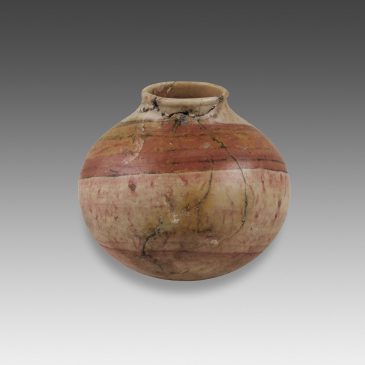
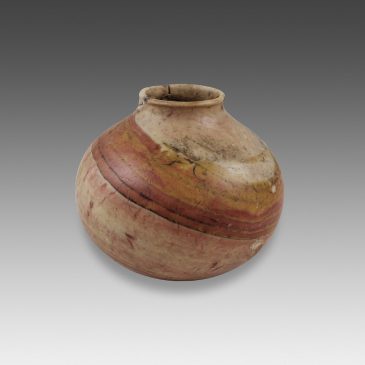
This small vessel was carved from a pinkish stone, criss-crossed with reddish-brown veins: the sculptor certainly took particular care in selecting the fragment of stone to work on, so as to make the most of its natural polychromy as decoration.
Small vessels such as the one under consideration, generally of modest size, are among the most characteristic products of the craftsmanship of the Buqras region (Middle Euphrates, present-day Syria), where, during the 7th millennium BC, a Neolithic village developed, whose economy was based on livestock rearing (goats) and agriculture (wheat and barley).
7th - 6th century B.C.
H: 8.2 cm
In stock
Product Description
This small vessel was carved from a pinkish stone, criss-crossed with reddish-brown veins: the sculptor certainly took particular care in selecting the fragment of stone to work on, so as to make the most of its natural polychromy as decoration.
The shape is simple but very well modelled: the spherical body, without handles, rests on a small, flattened but asymmetrical base; the rim is narrow and the lip rounded. The main veins cut diagonally across the body. The vessel’s capacity is limited, as the interior has not been completely hollowed out.
Small vessels such as the one under consideration, generally of modest size, are among the most characteristic products of the craftsmanship of the Buqras region (Middle Euphrates, present-day Syria), where, during the 7th millennium BC, a Neolithic village developed, whose economy was based on livestock rearing (goats) and agriculture (wheat and barley).
Pottery of this type is amongst the earliest examples of the new polished stone technique, which, from the beginning of the Neolithic period, gradually replaced the method of chipping or flaking stone: despite their age and small size, the Buqras vases demonstrate a high level of skill in this field (careful polishing, regular shapes). Techniques involving turning and rubbing the stone were now in common use: a tool such as a drill was used to hollow out the interior, a lathe to round off the exterior shape, and patient polishing to achieve a smooth finish.
The considerable time required to produce these vessels and their small capacity probably meant they were luxury items intended to hold precious and rare materials.


