
Ancient Art and Antiquities For Sale

Cart

View Cart
  • No products in the cart.
  • My Account
    • Edit address
    • Change password
    • View order
  • English
  • Login / Register
  • HOME
  • SHOP
  • ABOUT US
  • BLOG
  • CONTACT
  • BILIANAK.
  • PHOENIX ANCIENT ART
Back to top

Near Eastern Small Stone Jar

Home  / Vessels / Near Eastern Small Stone Jar
View cart “Near Eastern Spouted Bowl” has been added to your cart.

Near Eastern Small Stone Jar
Neolithic Near Eastern Small Stone Jar

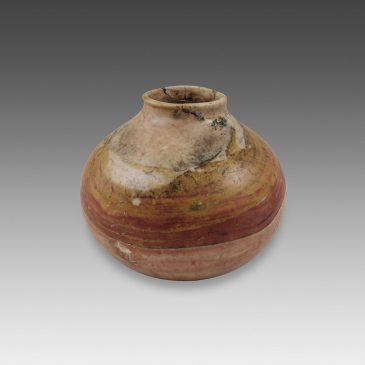
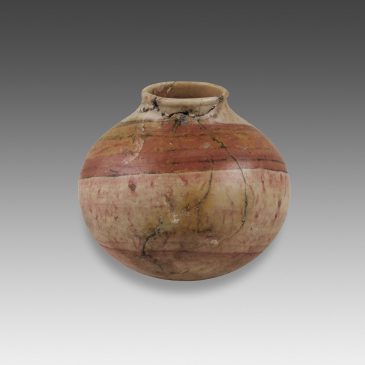
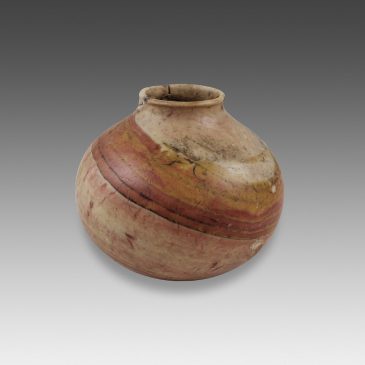
This small vessel was carved from a pinkish stone, criss-crossed with reddish-brown veins: the sculptor certainly took particular care in selecting the fragment of stone to work on, so as to make the most of its natural polychromy as decoration.
Small vessels such as the one under consideration, generally of modest size, are among the most characteristic products of the craftsmanship of the Buqras region (Middle Euphrates, present-day Syria), where, during the 7th millennium BC, a Neolithic village developed, whose economy was based on livestock rearing (goats) and agriculture (wheat and barley).

Near Eastern art
7th - 6th century B.C.
H: 8.2 cm

In stock

In stock

Price:CHF 3'300

Category: Vessels. Tag: « Token » with Flower Patterns.

Love it, share it!

  • Description
  • Additional information
  • Product Inquiry

Product Description

This small vessel was carved from a pinkish stone, criss-crossed with reddish-brown veins: the sculptor certainly took particular care in selecting the fragment of stone to work on, so as to make the most of its natural polychromy as decoration.
The shape is simple but very well modelled: the spherical body, without handles, rests on a small, flattened but asymmetrical base; the rim is narrow and the lip rounded. The main veins cut diagonally across the body. The vessel’s capacity is limited, as the interior has not been completely hollowed out.
Small vessels such as the one under consideration, generally of modest size, are among the most characteristic products of the craftsmanship of the Buqras region (Middle Euphrates, present-day Syria), where, during the 7th millennium BC, a Neolithic village developed, whose economy was based on livestock rearing (goats) and agriculture (wheat and barley).

Pottery of this type is amongst the earliest examples of the new polished stone technique, which, from the beginning of the Neolithic period, gradually replaced the method of chipping or flaking stone: despite their age and small size, the Buqras vases demonstrate a high level of skill in this field (careful polishing, regular shapes). Techniques involving turning and rubbing the stone were now in common use: a tool such as a drill was used to hollow out the interior, a lathe to round off the exterior shape, and patient polishing to achieve a smooth finish.
The considerable time required to produce these vessels and their small capacity probably meant they were luxury items intended to hold precious and rare materials.

Additional information

Culture

Near Eastern art

Datation

7th – 6th century B.C.

Dimensions

H: 8.2 cm

Type

Vessel

Material

Limestone

Colors

Pink

Condition

Complete and in excellent condition, except for some splinters and some cracks; glued fragments (lip).

Serial Number

33163

Other Products

  • Roman Kohl Container
    Details Add to cart
    ADDED

    Roman Kohl Container

    Roman Kohl Container

    This blown glass bottle is transparent, but shows pale gray shades. The patina adds a beautiful polychromy ranging from gold to violet-blue, whose appearance depends on the light.

    CHF 3'000 Read More
  • Details Add to cart
    ADDED

    Small Bowl

    Hellenistic Small Glass Bowl

    This core-formed bowl is simply decorated with lathe-cut grooves just below the lip. The base is slightly concave. Towards the end of the Hellenistic period, glass definitely supplanted clay as a raw material for the manufacture of containers in all areas of daily life. With versatility like no other known material in ancient times, abundant availability, lightness and ease of use, glass enabled the imitation of a wide range of other materials (precious metals especially), whether in the form, the design or the color.

    CHF 1'400 Read More
  • Details Add to cart
    ADDED

    Small Flask in the shape of a Date

    Rated 4.00 out of 5

    Small Flask in the shape of a Date

    A beautiful, small Roman glass flask that imitates the shape of a date. The vertical grooves recall in a very realistic way the wrinkles of the dried fruit. The vessel is complete and intact.

    CHF 2'750 Read More

Blog

Antique Idols

As soon as humans were able to think, they consistently […]

Antiquity’s Colors

English Translation Soon Les œuvres qui nous sont parvenues de […]

Glassware production

Glass, a luxury and exquisite material, whose technical virtuosity reached […]

Categories

  • Artifacts
  • Events & exhibitions
  • Facts & Figures
  • The gallery

Archives

  • December 2015
  • June 2015
  • March 2015
  • January 2015
  • December 2014
  • November 2014
  • October 2014
  • September 2014
  • August 2014
  • FAQs
  • Terms of Use
  • Terms of Sale
  • Contact us

©Designed by Webgenève - Création de site internet


Rue Etienne Dumont, 9 1204 Geneva
Tel. +4122 301 9378
Email: contact@young-collectors.com

This website uses cookies. If you continue browsing this website, your action is considered to be a cookie policy acceptance.
