
Oenochoe with Trilobate Spout

Oenochoe with Trilobate Spout
Oenochoe with Trilobate Spout
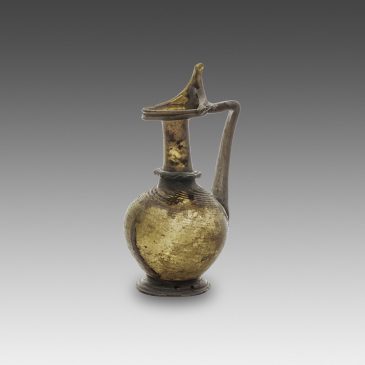
The shape is elegant, with a globular body supported by a circular foot with an elaborate profile, and a long cylindrical neck ending in a smooth rim. The handle is distinctive: at its end, it features a large triangular decorative element, which also provides a comfortable resting place for the thumb whilst pouring.
From the 2nd century AD onwards, the Romans tended to prefer glass vessels of a natural colour (transparent, slightly bluish or green) rather than bright hues, as had been the case at the very beginning of the Imperial period.
4th century A.D.
H: 25.5 cm
In stock
Product Description
The vessel is made of transparent blown glass with greenish highlights. The technical and aesthetic qualities of this jug are remarkable (balanced shape, very thin glass, fine formal precision). The base, which is only slightly concave, shows some traces of the blow mark. The decoration is achieved by blowing the glass mass into a mould with vertical ridges; after removing the jug from the mould, the glassmaker gently twists the glass, giving the raised lines their spiral pattern.
The shape is elegant, with a globular body supported by a circular foot with an elaborate profile, and a long cylindrical neck ending in a smooth rim. The handle is distinctive: at its end, it features a large triangular decorative element, which also provides a comfortable resting place for the thumb whilst pouring.
From the 2nd century AD onwards, the Romans tended to prefer glass vessels of a natural colour (transparent, slightly bluish or green) rather than bright hues, as had been the case at the very beginning of the Imperial period. At the same time, the range of shapes expanded, not only with the introduction of new vessels—the precise purpose of which is sometimes unknown—but also with the proliferation of variations on existing forms.
Easy to identify and work with, glass is chemically neutral and does not react with the materials it is used to transport, which ensures optimal preservation of perishable goods, such as food or cosmetics. Thanks to the possibility of varying its colouring infinitely, the use of glass allowed glassmakers to imitate a wide range of other materials, whether in terms of shape, design or colour. The glass trade mainly involved raw glass (often sourced from the Levantine coast) and groisil (broken glass and debris); by contrast, cosmetics, which constituted a significant branch of ancient trade, were generally packed into their small containers near the place of production and transported by ship.
Everyday tableware, due to its fragility, was manufactured in local workshops.


