
Egyptian, Third Intermediate Period, 21st Dynasty, ca. 1000 B.C.
Depicted mummiform, bright blue in color, with details in black, including the eyes and brows, a fillet in her hair and a hoe in each of her fisted hands, with six rows of hieroglyphs, reading: “Instructions of the Osiris, the Divine Adoratress Henut-tawy, She says: ‘O these shabty!” and continuing with a form of the standard shabti text from Chapter 6 of The Book of the Dead.
The ‘token’ (the term is chosen solely because of its shape, with no reference to its ancient use, which is currently unknown) is carved from a small lapis lazuli pebble of a beautiful azure blue, veined with grey in places.
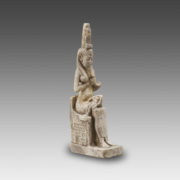
Egyptian faience Amulet representing Isis Lactans from the 7th-1st century B.C. Isis is seated on a low-backed, richly ornamented throne. The goddess holds little Horus on her knees, whom she is breastfeeding. She wears a finely braided wig surmounted by a small throne, Isis’s primary attribute. Complete and in good condition even if Horus’ head and the left hand of the goddess are lost.
The vessel, wheel-thrown, is made of light grey-beige clay covered with a white engobe. The decoration appears to be painted in black beneath a magnificent turquoise glaze, which is slightly thicker on the base where it has partially built up.
The technique, form and decoration are characteristic of the highly glossy ceramics produced in the workshops of the city of Kashan, situated in the centre of present-day Iran.
This cut-glass bottle features a three-dimensional geometric design composed of triangular facets. Its size is typical for this class of small perfume vases. The transparent glass reveals ice-colored reflections.
