
Ancient Attic Greek Black-Figure Lekythos
This lekythos is a tall vessel with a single handle attached to the broad shoulder terminating in a narrow neck and a rather large, semi-spherical mouth covered in black. The lower part of the body and a circular foot are also painted in black. The neck received a delicate decoration of tendrils of ivy with typical heard-shape leaves and stylized berries; it is separated from the shoulder by a band of tongues. The shoulder has a chain of seven, prominently painted palmettes.
Ancient Corinthian Greek Terracotta Lekanis with Panthers, a Sphinx, and Harpies
The lekanis has twin spurred handles on either side of a shallow footed bowl, decorated by three rows of red pomegranates along the rim and a series of red, black, and clay colored bands below
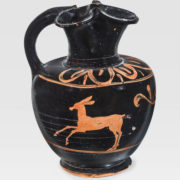
Ancient Apulian Xenon Ware Oinochoe
A trefoil oinochoe with spreading foot and cylindrical handle, The body painted with a deer and an inverted palmette flanked by scrolls, egg-and-dart on the shoulder.
Olpe with volute handle
The olpe is made of silver sheet. Its body, shaped like a teardrop, is supported by a low, truncated conical foot; its rounded shoulder tapers into a low, flared neck. With its airy, sinuous outline, the handle lends the vessel an even more elegant shape.
Greek terracotta figure showing the myth of Europe
The group comprises two figures: with natural grace, a young woman rides astride a bull that is galloping rapidly towards the viewer’s right. Indeed, the young woman is Europa (the mythological figure after whom our continent is named), who was one of the three daughters of the King of Tyre (a major Phoenician coastal city). She was abducted by Zeus on the beach where she was playing with her sisters: the god appeared to her in the form of a magnificent white bull and carried her, riding the waves of the sea, all the way to Crete.
Bronze Figure of a Man wearing a Chlamyd
The statuette is made of solid bronze. It depicts a standing male figure, clad in a short cloak (which the Greeks called a chlamys) fastened over the right shoulder with a circular fibula. The man extends his right arm towards the viewer, whilst his left arm is entirely concealed beneath the cloak. In his visible hand, clenched into a fist, he held an attribute. His feet are clad in high ankle boots, fastened with incised laces. His hair, cut short, covers his head like a cap; a few strands are indicated by regular engravings. A button in the centre of the skull probably served to secure a headdress.
Silver Phiale with Repousse Decoration
A medium-sized, perfectly circular phiale, with a low wall. The body is hollow with a very flared rim; it was hammered from a single, thin sheet of silver. The decoration was entirely carried out in repoussé work, chased from inside and/or outside: it is composed of a central medallion (the omphalos) surrounded by a stem of half-moons alternately surmounted by five lotus flowers and five ovolo patterns.
Ex-Voto in the shape of a Female Head
This veiled female head is carved in very high relief on the plaque, whose edges are curved. The two vertical edges, visible in the lower plaque, indicate the borders of the veil. Such protomes were largely widespread in the Greek world, in Attic but also in Eastern Greece and in the Western colonies, between the 6th and the early 5th century B.C.
Grotesque Terracotta Head (perhaps a Mime or an Actor)
The statuettes of “grotesques” often represented mimes, street actors, music players, dancers, or even street vendors or workers suffering from physical deformities or afflictions that the sculptors treated in an exaggerated manner, to create a caricature-like effect. At the end of the Hellenistic period, in the large urban centers such as Rome and Alexandria, the theatrical genre of pantomime (according to tradition, this genre was created by Sophron of Syracuse in the 5th century B.C. already) was very popular.
Grotesque Mask (Mime or Aulos Player)
This face certainly represents a male figure; it shows some of the distinctive features of the Greek-Roman images known as “grotesque”, such as the big aquiline and pointed nose, the strongly marked, frowning eyebrows and the wrinkled forehead.
Group representing a Grotesque Nurse and her Baby
This statue was cast into a rosy beige clay covered with a white slip. The old woman, is seated on a stool; her face is covered with a grotesque mask and her gaze directed toward the baby she holds in her naked arms.
Small Mycenaean Pear-Shaped Jar
Skillfully wheel-made vessel provided with three handles that were modeled separately and applied to the shoulder before the firing process.
This vessel with a sinuous profile and a circular, narrow base is very characteristic of Mycenaean culture: it is the reduced version of the large jars that can often be found in tombs and that would have served for the storage of the products used during funerary rituals.
©Designed by Webgenève - Création de site internet

Rue Etienne Dumont, 9 1204 Geneva
Tel. +4122 301 9378
Email: contact@young-collectors.com