
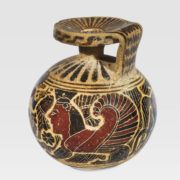
Ancient Corinthian Terracotta Aryballos with Warriors in combat
Attributed to the Warrior Group
The spherical aryballos depicts two hoplite figures in combat, flanked on one side by a seated sphinx and a horseman on the other. Rosettes and amorphous shapes decorate the remaining planes, with many details painted in red throughout. Tongues adorn the top of the rim and shoulder, zig-zags band along the handle, and a whirl with recessed center features on the underside.
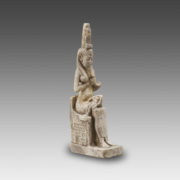
Amulet representing Isis Lactans
Egyptian faience Amulet representing Isis Lactans from the 7th-1st century B.C. Isis is seated on a low-backed, richly ornamented throne. The goddess holds little Horus on her knees, whom she is breastfeeding. She wears a finely braided wig surmounted by a small throne, Isis’s primary attribute. Complete and in good condition even if Horus’ head and the left hand of the goddess are lost.
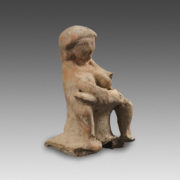
Statuette of a women breast-feeding a child
This statuette belongs to a significant series of figurines with similar characteristics originating from the Phoenician and Punic worlds. Generally dated to the 7th–6th centuries B.C., they may be standing or seated, holding a child or various attributes (musical instruments, a fan, ears of grain, etc.) or simply holding their breast or belly: in the latter case, they are often called dea gravida
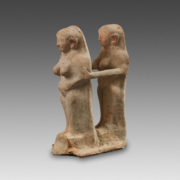
Group of two feminine statuettes
Levantine terracotta Group of two feminine statuettes from the 7th-6th century B.C. Complete and in good condition. Big chips on the basis. Concretion and few polychromy remains (brown-red).
This group belongs to a significant series of figurines with similar characteristics originating from the Phoenician and Punic worlds. Generally dated to the 7th–6th centuries B.C., they may be standing or seated, carrying a child or various attributes (musical instruments, a fan, ears of grain, brooches, etc.) or simply holding their breast or belly: in the latter case, they are often called dea gravida.
Twisted Bracelet
The bracelet, which, given its size, was most likely worn on the arm rather than the wrist, is made of a long, thick twisted bronze wire. Its ends, which are very close together, are flat and decorated with a series of incised vertical lines.
Amulet of a standing Bes
As usual, Bes sports a grimacing, grotesque expression, which makes him appear almost hilariously amused and thus portrays him as a positive and benevolent figure: his face is flattened and viewed from the front, with a wrinkled forehead crossed by thick eyebrows, wide-open eyes, a broad, flattened nose, ears reminiscent of a feline’s, and a beard ending in large, spiraling curls.
Mummy Faience Bead Mask
This mask, delineated by three fringes of white, red and black beads, clearly highlights the anatomical details connected with the senses: the ears, the eyes with the black irises, the nose and the mouth made of red beads.
©Designed by Webgenève - Création de site internet

Rue Etienne Dumont, 9 1204 Geneva
Tel. +4122 301 9378
Email: contact@young-collectors.com