
Ancient Art and Antiquities For Sale

Cart

Empty Cart
  • No products in the cart.
  • My Account
    • Edit address
    • Change password
    • View order
  • English
  • Login / Register
  • HOME
  • SHOP
  • ABOUT US
  • BLOG
  • CONTACT
  • BILIANAK.
  • PHOENIX ANCIENT ART
Back to top

Mummy Faience Bead Mask

Home  / Funerary Mask / Mummy Faience Bead Mask

  • Mummy Faience Bead Mask

Mummy Faience Bead Mask

Mummy Faience Bead Mask

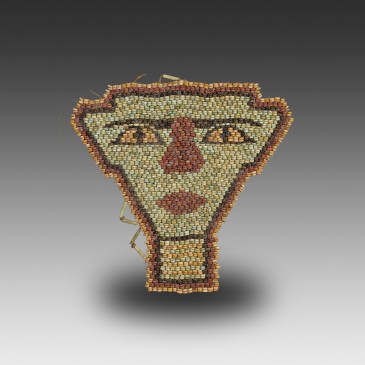
This mask, delineated by three fringes of white, red and black beads, clearly highlights the anatomical details connected with the senses: the ears, the eyes with the black irises, the nose and the mouth made of red beads.

Egyptian
6th century B.C., 7th century B.C.
Dim: 16 x 16 cm

In stock

In stock

Price:CHF 4'900

Category: Funerary Mask. Tags: Beads, Egypt, egyptian, Faience, Mask, Mummy, Mummy Faience Bead Mask.

Love it, share it!

  • Description
  • Additional information
  • Product Inquiry

Product Description

This mask, delineated by three fringes of white, red and black beads, clearly highlights the anatomical details connected with the senses: the ears, the eyes with the black irises, the nose and the mouth made of red beads. The turquoise background is characteristic of “Egyptian” faience. A necklace composed of horizontal rows adorns the neck.

As was already the case during the Old and the Middle Kingdom, the wealthy Egyptians of the Late Period started again to adorn their mummies with a net composed of hundreds of multicolored faience beads: these rich and elaborate adornments varied depending on the financial possibilities of the deceased. Some nets might therefore include semiprecious stones and gold-leafed ornaments in addition to the faience elements.

This adornment was as a rectangular cloth that covered the whole body of the mummy, aside from the head (usually hidden by a large face mask).

Most often, the nets included various decorative patterns, which were carefully chosen because of their prophylactic meaning in the framework of Egyptian funerary beliefs: the winged scarab, the usekh necklace, the mourning Isis, the geniuses called the “four sons of Horus”, the face (like our example) representing the goddess Nut, goddess of the Sky, who offered food and drink to the deceased.

The nets were composed of turquoise faience beads, while the decorative patterns were polychromatic: the faces might be turquoise blue, yellow, white or, more rarely, red.

Additional information

Culture

Egyptian

Datation

6th century B.C., 7th century B.C.

Dimensions

Dim: 16 x 16 cm

Type

Funerary Mask

Material

Faience

Colors

Black, Red, Turquoise, White

Condition

The face mask is complete and in very good condition. Only small elements of the net are preserved on the left of the jaw and neck.

Serial Number

7190

Other Products

  • Details Add to cart
    ADDED

    Egyptian faience ushabti of Queen Henuttawy

    Egyptian faience ushabti of Queen Henuttawy

    Egyptian, Third Intermediate Period, 21st Dynasty, ca. 1000 B.C.

    Depicted mummiform, bright blue in color, with details in black, including the eyes and brows, a fillet in her hair and a hoe in each of her fisted hands, with six rows of hieroglyphs, reading: “Instructions of the Osiris, the Divine Adoratress Henut-tawy, She says: ‘O these shabty!” and continuing with a form of the standard shabti text from Chapter 6 of The Book of the Dead.


    CHF 35'000 Read More
  • Amulet in the shape of a Frog
    Details Add to cart
    ADDED

    Amulet in the shape of a Frog

    Amulet in the shape of a Frog

    Made of faience and probably molded, this amulet represents a frog in stylized forms. The arched body has no indication of forelegs, while the hind legs are folded in a W-shape along the body, as if the animal was ready to spring.

    CHF 2'500 Read More
  • White-glazed Egyptian Faience Ushabti (Dynasty 21-22)
    Details Add to cart
    ADDED

    White-glazed Egyptian Faience Ushabti (Dynasty 21-22)

    White-glazed Egyptian Faience Ushabti (Dynasty 21-22)

    This ushabti represents a male figure with a short false beard and a rounded wig, only painted on the front part of the statuette. From the late New Kingdom on, the iconography and the purpose of the ushabtis were standardized: from substitutes for the deceased, these figurines became slaves and served their masters in the chores of daily life.

    CHF 4'600 Read More

Blog

Antique Idols

As soon as humans were able to think, they consistently […]

Antiquity’s Colors

English Translation Soon Les œuvres qui nous sont parvenues de […]

Glassware production

Glass, a luxury and exquisite material, whose technical virtuosity reached […]

Categories

  • Artifacts
  • Events & exhibitions
  • Facts & Figures
  • The gallery
  • FAQs
  • Terms of Use
  • Terms of Sale
  • Contact us

©Designed by Webgenève - Création de site internet


Rue Etienne Dumont, 9 1204 Geneva
Tel. +4122 301 9378
Email: contact@young-collectors.com

This website uses cookies. If you continue browsing this website, your action is considered to be a cookie policy acceptance.
