
Ancient Art and Antiquities For Sale

Cart

View Cart
  • No products in the cart.
  • My Account
    • Edit address
    • Change password
    • View order
  • English
  • Login / Register
  • HOME
  • SHOP
  • ABOUT US
  • BLOG
  • CONTACT
  • BILIANAK.
  • PHOENIX ANCIENT ART
Back to top

Statuette of a Human-Headed Bull

Home  / Amulets / Statuette of a Human-Headed Bull
View cart “Anepigraphic Scarab” has been added to your cart.

Statuette of a Human-Headed Bull
Statuette of a Human-Headed Bull

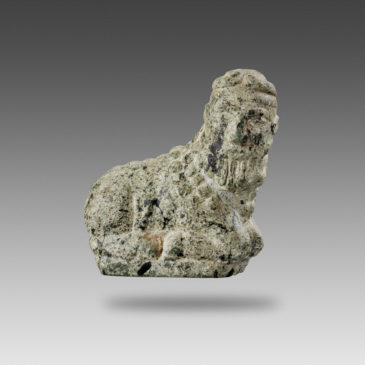
This Statuette of a Human-Headed Bull represents a very popular mythological hybrid figure that was largely widespread in Near Eastern iconography (especially in glyptics) from the Sumerian period, that is the bull with a bearded human head, wearing a headgear (tiara) adorned with a single pair of horns.

Near Eastern art
2nd millenium B.C., 3rd millenium B.C.
Dim: 4.4 x 5.4 cm

In stock

In stock

Price:CHF 9'200

Categories: Amulets, Animals, Sculpture.

Love it, share it!

  • Description
  • Additional information
  • Product Inquiry

Product Description

This Statuette of a Human-Headed Bull represents a very popular mythological hybrid figure that was largely widespread in Near Eastern iconography (especially in glyptics) from the Sumerian period, that is the bull with a bearded human head, wearing a headgear (tiara) adorned with a single pair of horns.

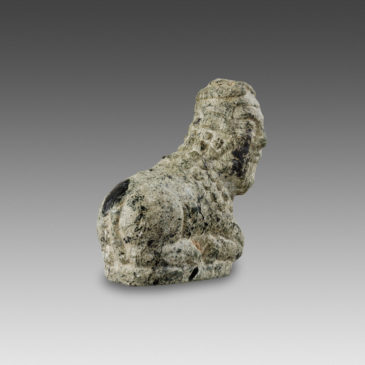
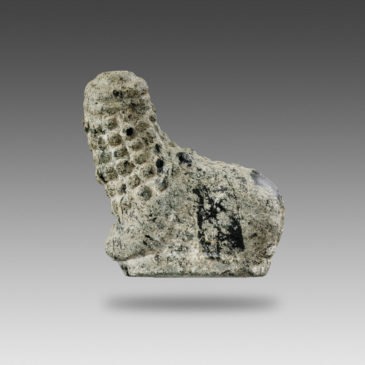
The animal is seated on a low, elliptical base with its legs folded under its body; its head is turned to the right, towards the viewer. Many anatomical details are rendered by incisions or by barely modeled volumes, like the legs or the coat represented by small beads on the neck, the upper back and the small tail. The face depicts a middle-aged man, with large eyes surrounded by eyebrows, a broad-winged nose, a small fleshy mouth and a long beard ending in a curl. The posterior part is less well finished and shows fewer details.

Maybe because of its state of preservation and of its miniature size, this figurine stylistically appears undeveloped and a bit naive.

A protective genie often found both in monumental statuary and minor arts, the human-headed bull was supposed to protect its owner from all kinds of demons: the terracotta examples or the small statuettes were buried following specific rituals at certain gates or doorways, so as to ward off evil spirits or to protect a particular room. These statuettes were often given to the deity in shrines, as a continuous offering.

Slightly more than a millennium after this figurine, one can find huge human-headed bulls carved in front of the doors of the great Assyrian cities, as a protection against enemies, but also against epidemics and other misfortunes.

Additional information

Culture

Near Eastern art

Datation

2nd millenium B.C., 3rd millenium B.C.

Dimensions

Dim: 4.4 x 5.4 cm

Type

Amulet, Animal, Sculpture

Material

Stone

Colors

Green

Condition

Complete, but the superficial wear and the presence of concretions prevent the accurate understanding of the details.

Serial Number

15162

Other Products

  • Details Add to cart
    ADDED

    Pendant / Amulet with the Head of Bes

    The Pendant / Amulet with the Head of Bes

    It is in the shape of a small flat bust, with a slightly rounded bottom. At the level of the crown, it is pierced horizontally for a suspension string, which would have allowed the amulet to be worn as a necklace, for example.

    CHF 3'800 Read More
  • Byzantine stone animal : double-headed
    Details Add to cart
    ADDED

    Byzantine stone animal: double-headed

    Byzantine stone animal: double-headed

    Carved from two fragments of dark green stone mottled with light patches (steatite probably), these two objects represent animals with highly stylized and abstract shapes.

    CHF 2'300 Read More
  • Grotesque Terracotta Head (Mime or Actor)
    Details Add to cart
    ADDED

    Grotesque Terracotta Head (perhaps a Mime or an Actor)

    Grotesque Terracotta Head (perhaps a Mime or an Actor)

    The statuettes of “grotesques” often represented mimes, street actors, music players, dancers, or even street vendors or workers suffering from physical deformities or afflictions that the sculptors treated in an exaggerated manner, to create a caricature-like effect. At the end of the Hellenistic period, in the large urban centers such as Rome and Alexandria, the theatrical genre of pantomime (according to tradition, this genre was created by Sophron of Syracuse in the 5th century B.C. already) was very popular.

    CHF 8'200 Read More

Blog

Antique Idols

As soon as humans were able to think, they consistently […]

Antiquity’s Colors

English Translation Soon Les œuvres qui nous sont parvenues de […]

Glassware production

Glass, a luxury and exquisite material, whose technical virtuosity reached […]

Categories

  • Artifacts
  • Events & exhibitions
  • Facts & Figures
  • The gallery
  • FAQs
  • Terms of Use
  • Terms of Sale
  • Contact us

©Designed by Webgenève - Création de site internet


Rue Etienne Dumont, 9 1204 Geneva
Tel. +4122 301 9378
Email: contact@young-collectors.com

This website uses cookies. If you continue browsing this website, your action is considered to be a cookie policy acceptance.
