
Ancient Art and Antiquities For Sale

Cart

Empty Cart
  • No products in the cart.
  • My Account
    • Edit address
    • Change password
    • View order
  • English
  • Login / Register
  • HOME
  • SHOP
  • ABOUT US
  • BLOG
  • CONTACT
  • BILIANAK.
  • PHOENIX ANCIENT ART
Back to top

Statuette of two seated young bulls

Home  / Animals / Statuette of two seated young bulls
  • Statuette of two seated young bulls
  • Statuette of two seated young bulls
  • Statuette of two seated young bulls

Statuette of two seated young bulls

Statuette of two seated young bulls

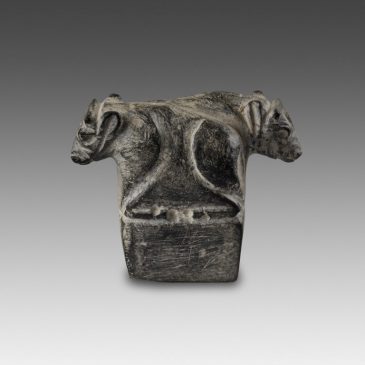
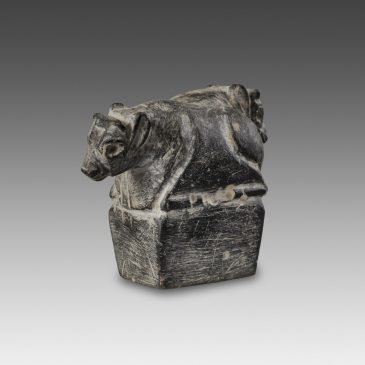
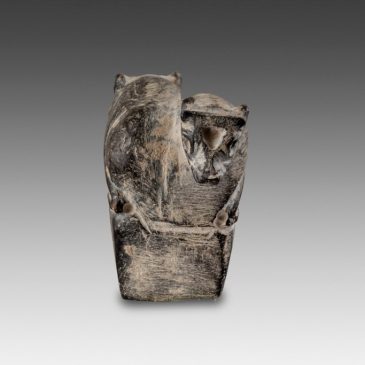
This small, beautiful object is composed of two elements: a parallelepiped that serves as a base for two statuettes of young bulls, whose bodies are merged together and placed head to toe. The animals are seated on the floor, their legs folded under their bodies. In spite of the stylization of the figurines, partly related to their miniature size, the artist skillfully rendered the proportions, the position and anatomy of the bulls. The delicate expression of their muzzle and their somewhat thick appearance certainly tend to imitate the naivety and clumsiness of a young animal.

Near Eastern
3000 B.C.
H: 4.5 cm

In stock

In stock

Price:CHF 18'000

Categories: Animals, Sculpture. Tags: Bull, Near Eastern, Statuette, Stone.

Love it, share it!

  • Description
  • Additional information
  • Product Inquiry

Product Description

This small, beautiful object is composed of two elements: a parallelepiped that serves as a base for two statuettes of young bulls, whose bodies are merged together and placed head to toe. The animals are seated on the floor, their legs folded under their bodies. In spite of the stylization of the figurines, partly related to their miniature size, the artist skillfully rendered the proportions, the position and anatomy of the bulls. The delicate expression of their muzzle and their somewhat thick appearance certainly tend to imitate the naivety and clumsiness of a young animal.

Under the base, the narrow, though long and deep, elliptical hole would have served to attach the statuette to its original support, the nature of which remains unknown: one can nevertheless assume that this object was a small ex-voto in a shrine or a temple, or a decorative element belonging to a larger statue, to a piece of wooden furniture, etc.

Over the millennia, Mesopotamian artists produced an impressive bestiary, including all sorts of species: mammals, insects, aquatic animals, reptiles, etc. Bovids and caprids (because of the important role they played in the economic structure of ancient societies) are among the most popular subjects: dedicated to and suspended in shrines, these small statuettes were mainly used as substitutes for the animal brought for sacrifice. Their presence was a symbolic and perpetual offering that would have pleased the deity, and highlighted the needs of the city and of its inhabitants.
Additional information

Culture

Near Eastern

Datation

3000 B.C.

Dimensions

H: 4.5 cm

Type

Animal, Sculpture

Material

Steatite

Colors

Black

Condition

Virtually intact, but the inlays of the eyes and forehead are now lost; small chips. Minor concretions.

Serial Number

12414

Other Products

  • Details Add to cart
    ADDED

    Statuette of a Wild Sheep or a Ram

    Statuette of a Wild Sheep or a Ram

    This Statuette of a Wild Sheep or a Ram was carved from a thin stone pebble, which is still partially translucent, despite the current dark and worn appearance of the surface.

    CHF 5'200 Read More
  • Details Add to cart
    ADDED

    Statuette of a Human-Headed Bull

    Statuette of a Human-Headed Bull

    This Statuette of a Human-Headed Bull represents a very popular mythological hybrid figure that was largely widespread in Near Eastern iconography (especially in glyptics) from the Sumerian period, that is the bull with a bearded human head, wearing a headgear (tiara) adorned with a single pair of horns.

    CHF 9'200 Read More
  • Grotesque Terracotta Head (Mime or Actor)
    Details Add to cart
    ADDED

    Grotesque Terracotta Head (perhaps a Mime or an Actor)

    Grotesque Terracotta Head (perhaps a Mime or an Actor)

    The statuettes of “grotesques” often represented mimes, street actors, music players, dancers, or even street vendors or workers suffering from physical deformities or afflictions that the sculptors treated in an exaggerated manner, to create a caricature-like effect. At the end of the Hellenistic period, in the large urban centers such as Rome and Alexandria, the theatrical genre of pantomime (according to tradition, this genre was created by Sophron of Syracuse in the 5th century B.C. already) was very popular.

    CHF 8'200 Read More

Blog

Antique Idols

As soon as humans were able to think, they consistently […]

Antiquity’s Colors

English Translation Soon Les œuvres qui nous sont parvenues de […]

Glassware production

Glass, a luxury and exquisite material, whose technical virtuosity reached […]

Categories

  • Artifacts
  • Events & exhibitions
  • Facts & Figures
  • The gallery
  • FAQs
  • Terms of Use
  • Terms of Sale
  • Contact us

©Designed by Webgenève - Création de site internet


Rue Etienne Dumont, 9 1204 Geneva
Tel. +4122 301 9378
Email: contact@young-collectors.com

This website uses cookies. If you continue browsing this website, your action is considered to be a cookie policy acceptance.
