
Neolithic Polished Axehead


Neolithic Polished Axehead
Neolithic Polished Axehead
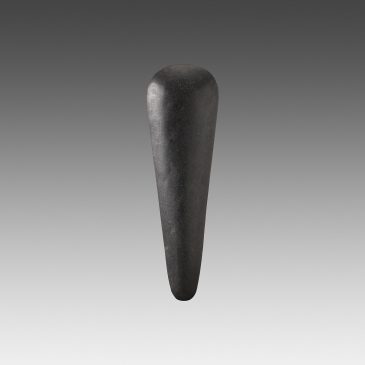
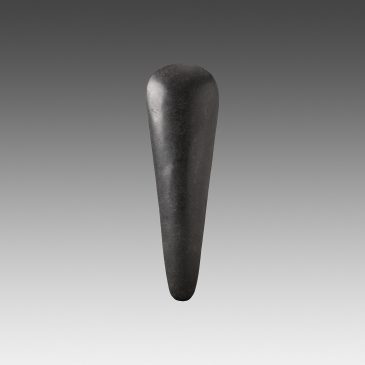
The axe was carved from a long, slender flake of stone, of a uniform, almost black colour. Its shape resembles that of a teardrop, with one end being thinner and almost pointed, whilst the other (which forms the cutting edge) has a distinctly arched profile, but appears never to have been sharpened.
3rd millenium B.C., 4th millenium B.C.
Long : 27.3 cm
In stock
Product Description
The axe was carved from a long, slender flake of stone, of a uniform, almost black colour. Its shape resembles that of a teardrop, with one end being thinner and almost pointed, whilst the other (which forms the cutting edge) has a distinctly arched profile, but appears never to have been sharpened.
This type of axe was one of the key tools used by Neolithic farmers. It enabled them to fell trees and thus create new areas for cultivation in territories yet to be settled, which were covered in forests and vegetation that needed to be cleared.
They were first made by chipping or sawing, and then by whittling, shaping them as closely as possible to their final form in order to reduce the very long time usually spent on polishing. The handle was attached by drilling a long, narrow hole in a wooden stick, into which the narrow part of the axe was inserted and then secured with cord.
Exemplars as well-preserved and of such high technical and artistic quality as the one under consideration were probably symbols of prestige or power, rather than actual tools or weapons used on the battlefield. According to some archaeologists, who base their views partly on recent ethnological studies, the size of an axe was an indicator of its owner’s position in the hierarchy and of his wealth: the larger the tool, the more prominent a position he held within his clan or society.


