Ancient Art and Antiquities For Sale

Cart

View Cart
  • No products in the cart.
  • My Account
    • Edit address
    • Change password
    • View order
  • English
  • Login / Register
  • HOME
  • SHOP
  • ABOUT US
  • BLOG
  • CONTACT
  • BILIANAK.
  • PHOENIX ANCIENT ART
Back to top

Ring with the Bust of Askelpios

Home  / Gems, Seals & Intaglios / Ring with the Bust of Askelpios

  • View Cart You cannot add another "Compartmented Seal with a suspension Ring" to your cart.

Ring with the Bust of Askelpios

Ring with the Bust of Askelpios

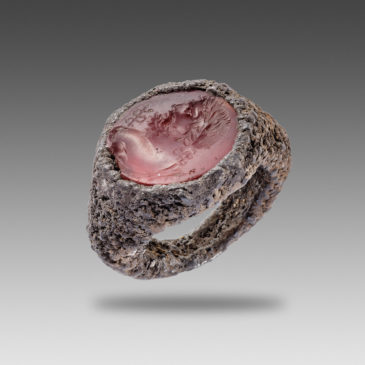
The ring is made of solid silver and is hexagonal in shape, but unfortunately the metal has suffered severe corrosion. It is topped by a circular cabochon, cut from a disc of bright red carnelian, which features, carved into its hollow centre, a magnificent male bust: the figure depicted, seen in left profile, is Asclepius, with a youthful appearance.

Roman
1st century A.D., 2nd century A.D.
Diam (inside of ring) : 1.4 cm

In stock

In stock

Price:CHF 3'800

Category: Gems, Seals & Intaglios.

Love it, share it!

  • Description
  • Additional information
  • Product Inquiry

Product Description

The ring is made of solid silver and is hexagonal in shape, but unfortunately the metal has suffered severe corrosion. It is topped by a circular cabochon, cut from a disc of bright red carnelian, which features, carved into its hollow centre, a magnificent male bust: the figure depicted, seen in left profile, is Asclepius, with a youthful appearance. His short but thick hair is rendered by small lines finely engraved into the stone; his beard is short. A wreath of elongated leaves encircles his forehead and is tied at the nape of his neck. A cloak, draped over his largely bare torso, is visible on his right shoulder, from where it falls towards his chest, following the rounded edge of the intaglio.

In addition to the general typology of the image, which corresponds – amongst other possibilities – to depictions of Asclepius/Aesculapius, the Greco-Roman god of medicine, the attribute engraved to the left of the bust confirms the identification: it is a staff with a snake coiled around it. This staff, sometimes known as the caduceus of Asclepius, was believed to have the power to cure diseases: it remains a widely recognised medical symbol to this day. The snake is probably a grass snake.

The intaglio is of exceptional artistic quality.
In ancient mythology, Asclepius played no particular role. He was the son of Apollo and Coronis, the daughter of the king of the Lapiths. To ensure his education, his father entrusted him to the centaur Chiron, who taught him the art of medicine. From Athena, he received as a gift two small vials containing the blood of Medusa, with which Asclepius could cause death and/or resurrect the dead. As the god made use of this gift on several occasions, Hades (the lord of the Underworld) complained to Zeus, who then struck down Apollo’s son with a thunderbolt to preserve the order of the world. However, Zeus transformed Asclepius into a constellation, Ophiuchus.

Asclepius was one of the most popular and revered gods of the ancient world: his principal sanctuary was at Epidaurus, in Argolis, where he healed pilgrims through incubation (a practice that involved sleeping in the sanctuary or temple of the god, who would then convey his instructions to the patient in the form of a dream or a vision).

Additional information

Culture

Roman

Datation

1st century A.D., 2nd century A.D.

Dimensions

Diam (inside of ring) : 1.4 cm

Type

Gem, Seal & Intaglio, Jewelry

Material

Silver, Cornelian

Colors

Red, Silver

Condition

Corroded silver. Intaglio in very good state of preservation.

Serial Number

33674

Other Products

  • Seal in the Shape of a Lion's Head
    Details Add to cart
    ADDED

    Seal in the Shape of a Lion’s Head

    Seal in the Shape of a Lion’s Head

    Modeled in the shape of a stylized leonine protome (the head is complete, but the body is a simple half-circle representing the mane of the animal), it was carved from a cream-colored limestone veined with red; it is pierced vertically by a hole and was therefore intended to be worn as a pendant (necklace or bracelet).

    The flat lower part of the object actually bears the seal of the owner and of his goods: it is adorned with drawings made with a bouterolle (a sort of drill).

    CHF 5'900 Read More
  • Seal in the shape of a Pig
    Details Add to cart
    ADDED

    Seal in the shape of a Pig

    Seal in the shape of a Pig

    This seal, modeled in the shape of a stylized pig (the head is complete, but the body is a simple half-circle), was carved from a cream-colored limestone; it is pierced by a hole and was therefore intended to be worn as a pendant (necklace or bracelet).

    CHF 6'000 Read More
  • Details Add to cart
    ADDED

    Hemispherical Syrian Limestone Seal with Animals

    Hemispherical Syrian Limestone Seal with Animals

    This seal was carved from a whitish limestone with darker undulated veins that give the impression of an artificial decoration, although it is perfectly natural. The object is pierced by a hole in its rounded part and would have therefore been worn on a string round the neck or wrist (necklace or bracelet).

    CHF 1'150 Read More

Blog

Antique Idols

As soon as humans were able to think, they consistently […]

Antiquity’s Colors

English Translation Soon Les œuvres qui nous sont parvenues de […]

Glassware production

Glass, a luxury and exquisite material, whose technical virtuosity reached […]

Categories

  • Artifacts
  • Events & exhibitions
  • Facts & Figures
  • The gallery
  • FAQs
  • Terms of Use
  • Terms of Sale
  • Contact us

©Designed by Webgenève - Création de site internet


Rue Etienne Dumont, 9 1204 Geneva
Tel. +4122 301 9378
Email: contact@young-collectors.com

This website uses cookies. If you continue browsing this website, your action is considered to be a cookie policy acceptance.