
Ancient Art and Antiquities For Sale

Cart

View Cart
  • No products in the cart.
  • My Account
    • Edit address
    • Change password
    • View order
  • English
  • Login / Register
  • HOME
  • SHOP
  • ABOUT US
  • BLOG
  • CONTACT
  • BILIANAK.
  • PHOENIX ANCIENT ART
Back to top

Greek terracotta figure showing the myth of Europe

Home  / Ex-Voto / Greek terracotta figure showing the myth of Europe
View cart “Statuette of a Wild Sheep or a Ram” has been added to your cart.
  • Greek terracotta figure showing the myth of Europe
  • Greek terracotta figure showing the myth of Europe

Greek terracotta figure showing the myth of Europe

Greek terracotta figure showing the myth of Europe

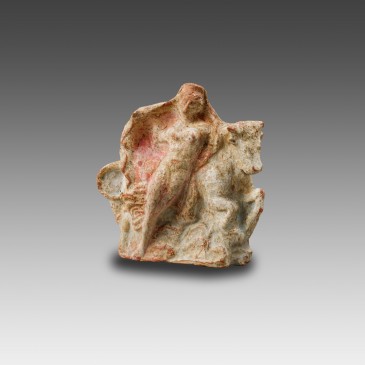
The group comprises two figures: with natural grace, a young woman rides astride a bull that is galloping rapidly towards the viewer’s right. Indeed, the young woman is Europa (the mythological figure after whom our continent is named), who was one of the three daughters of the King of Tyre (a major Phoenician coastal city). She was abducted by Zeus on the beach where she was playing with her sisters: the god appeared to her in the form of a magnificent white bull and carried her, riding the waves of the sea, all the way to Crete.

Greek, Southern Italian
2nd century B.C., 3rd century B.C.
ca. 14 x 14 cm

In stock

In stock

Price:CHF 8'500

Categories: Ex-Voto, Sculpture. Tags: Bull, Europe, Greek, Greek terracotta figure showing the myth of Europe, Polychromy, Statuette, terracotta.

Love it, share it!

  • Description
  • Additional information
  • Product Inquiry

Product Description

The group comprises two figures: with natural grace, a young woman rides astride a bull that is galloping rapidly towards the viewer’s right.
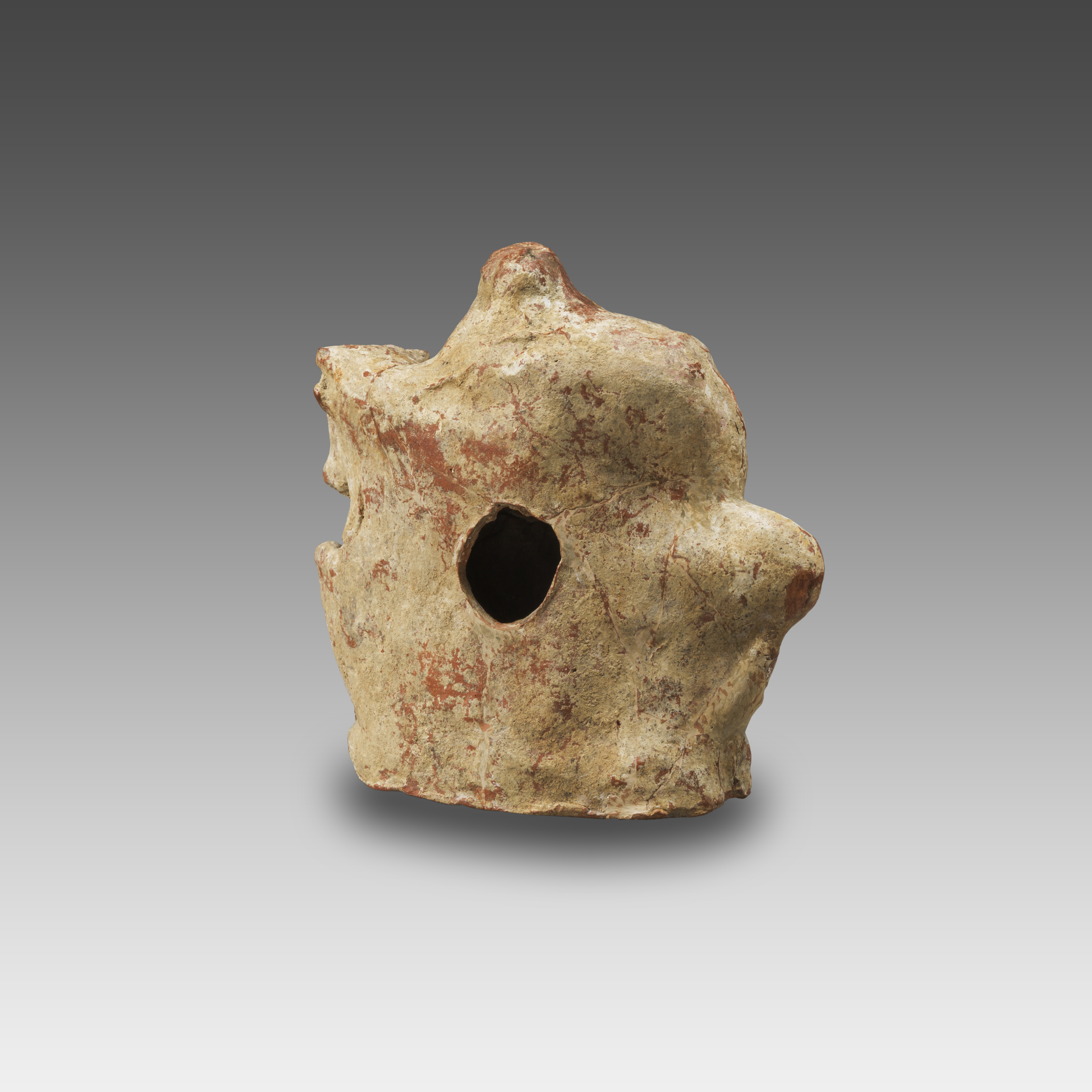
The piece is entirely hollow and was made using what was probably a bivalve mould; it is well detailed on the obverse but roughly modelled on the reverse; the vent hole is small and circular.

This image depicts a legend which, given the current political situation, takes on a very significant symbolic meaning. Indeed, the young woman is Europa (the mythological figure after whom our continent is named), who was one of the three daughters of the King of Tyre (a major Phoenician coastal city). She was abducted by Zeus on the beach where she was playing with her sisters: the god appeared to her in the form of a magnificent white bull and carried her, riding the waves of the sea, all the way to Crete. On this terracotta piece, the waves are clearly depicted in light blue beneath the animal’s hooves. Europe is depicted naked, but she is holding a flowing red cloak in her hands, which flutters in the wind behind her back, thus conveying the sense of the two figures’ rapid movement.

Although attested in several depictions (terracotta pieces, vase paintings, mosaics), this subject is not very common in Greco-Roman art. Already known from 5th-century BC Boeotian terracottas, the motif reproduced in this example subsequently appeared in the Italian colonial world, where Europa became the symbol of the soul carried away to the blissful shores of the afterlife.
Additional information

Culture

Greek, Southern Italian

Datation

2nd century B.C., 3rd century B.C.

Dimensions

ca. 14 x 14 cm

Type

Ex-Voto, Sculpture

Material

Terracotta

Colors

Red, White

Condition

Complete but reglued. Rests of polychromy.

Serial Number

27411

Other Products

  • Details Add to cart
    ADDED

    Ancient Roman Marble Cupid with a Bird

    Ancient Roman Marble Cupid with a Bird

    A small, statuette-size sculpture represents Cupid (Eros in Greek art) holding a big bird against his chest. The motif comes back to the Hellenistic art that introduced several charming representations of children or Erotes with their pets, little dogs or birds

    CHF 25'000 Read More
  • Stela representing a Woman
    Details Add to cart
    ADDED

    Stela representing a Woman

    Stela representing a Woman

    The stele is like a large, almost rectangular slab. It depicts the bust of a woman with a somewhat stiff and impersonal expression, carved in very high relief. The base, the back and the sides are flat and roughly hewn: it is possible that it served as a funerary stele.

    CHF 14'000 Read More
  • Bronze Figure of a Man wearing a Chlamyd
    Details Add to cart
    ADDED

    Bronze Figure of a Man wearing a Chlamyd

    Bronze Figure of a Man wearing a Chlamyd

    The statuette is made of solid bronze. It depicts a standing male figure, clad in a short cloak (which the Greeks called a chlamys) fastened over the right shoulder with a circular fibula. The man extends his right arm towards the viewer, whilst his left arm is entirely concealed beneath the cloak. In his visible hand, clenched into a fist, he held an attribute. His feet are clad in high ankle boots, fastened with incised laces. His hair, cut short, covers his head like a cap; a few strands are indicated by regular engravings. A button in the centre of the skull probably served to secure a headdress.

    CHF 9'200 Read More

Blog

Antique Idols

As soon as humans were able to think, they consistently […]

Antiquity’s Colors

English Translation Soon Les œuvres qui nous sont parvenues de […]

Glassware production

Glass, a luxury and exquisite material, whose technical virtuosity reached […]

Categories

  • Artifacts
  • Events & exhibitions
  • Facts & Figures
  • The gallery
  • FAQs
  • Terms of Use
  • Terms of Sale
  • Contact us

©Designed by Webgenève - Création de site internet


Rue Etienne Dumont, 9 1204 Geneva
Tel. +4122 301 9378
Email: contact@young-collectors.com

This website uses cookies. If you continue browsing this website, your action is considered to be a cookie policy acceptance.
