
Group of two feminine statuettes

Group of two feminine statuettes
Group of two feminine statuettes
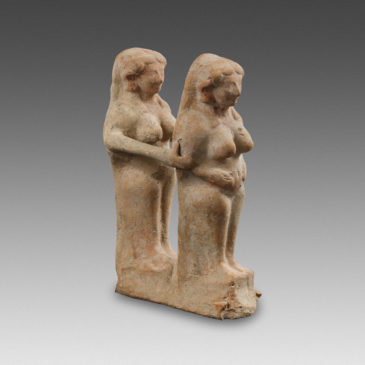
Levantine terracotta Group of two feminine statuettes from the 7th-6th century B.C. Complete and in good condition. Big chips on the basis. Concretion and few polychromy remains (brown-red).
This group belongs to a significant series of figurines with similar characteristics originating from the Phoenician and Punic worlds. Generally dated to the 7th–6th centuries B.C., they may be standing or seated, carrying a child or various attributes (musical instruments, a fan, ears of grain, brooches, etc.) or simply holding their breast or belly: in the latter case, they are often called dea gravida.
6th century B.C., 7th century B.C.
H max : 19.8 cm
Product Description
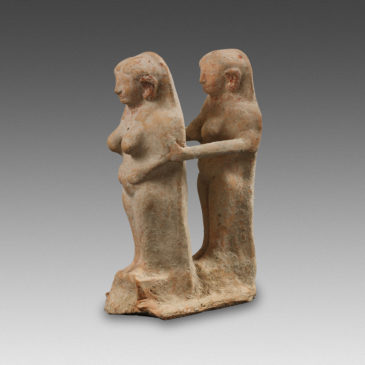
The set consists of two female figures standing one in front of the other: their feet rest on a rectangular base; only the front part of their bodies is sculpted, while their rounded backs show no anatomical detail. Two drainage holes are drilled beneath the base.
The two figures were cast separately, likely using the same mold; before firing, they were then joined and assembled in their current position. The difference in size between the statuettes (the one in the back is slightly smaller) can be explained either by a longer drying time or by a second-generation casting.
They are nude, with full, rounded breasts; their hairstyles, despite the wavy bangs and center part, are reminiscent of Egyptian fashion, with hair falling in a mass down the back and parted into two flat sections over the shoulders and upper chest. Their faces, necklines, ears, and parts of their hair (a diadem?) were painted reddish-brown.
The first woman, undoubtedly a woman in labor, rests her open hands on her large, pregnant belly. To reach her companion’s elbows, the other figure, standing behind her, stretches her slender yet disproportionately long arms forward: originally, her arms were modeled naturally against her belly, from where they were erased (though their original position has left a clearly visible trace).
This group belongs to a significant series of figurines with similar characteristics originating from the Phoenician and Punic worlds. Generally dated to the 7th–6th centuries B.C., they may be standing or seated, carrying a child or various attributes (musical instruments, a fan, ears of grain, brooches, etc.) or simply holding their breast or belly: in the latter case, they are often called dea gravida. Stylistically, particularly in their general forms and facial modeling, these figures already show a certain Greek artistic influence.
Typologically, this group has no exact parallels; nevertheless, it can be compared to two other groups—one from the Musée Bible et Orient in Fribourg and the other of Cypriot origin—in which the figure in the back, who appears to be seated and is more schematically rendered, is interpreted as a midwife. Nevertheless, here the significance of the second woman remains enigmatic, since she is standing and, above all, appears to be pregnant like her companion. In any case, it seems evident that this terracotta figure is connected to Near Eastern beliefs about fertility and fruitfulness: it is a beautiful testament to the piety of a Phoenician woman from the first millennium BCE, who may have created it as a votive offering to be presented at a sanctuary as a token of gratitude or as a prayer for a future birth.


