
Ancient Art and Antiquities For Sale

Cart

View Cart
  • No products in the cart.
  • My Account
    • Edit address
    • Change password
    • View order
  • English
  • Login / Register
  • HOME
  • SHOP
  • ABOUT US
  • BLOG
  • CONTACT
  • BILIANAK.
  • PHOENIX ANCIENT ART
Back to top

Statuette of a Dwarf Silene

Home  / Metalwork / Statuette of a Dwarf Silene
View cart “Stela representing a Woman” has been added to your cart.
  • Statuette of a Dwarf Silene-20965
  • Statuette of a Dwarf Silene-20965-1
  • Statuette of a Dwarf Silene-20965

Statuette of a Dwarf Silene
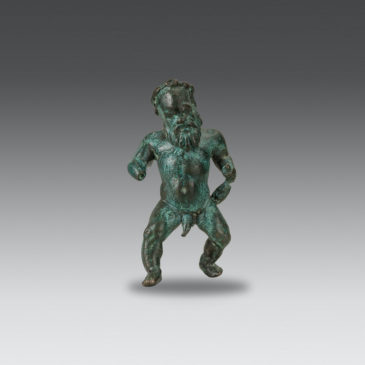
Imperial Romain Bronze Statuette of a Dwarf Silene

from the 1st-2nd century A.D.

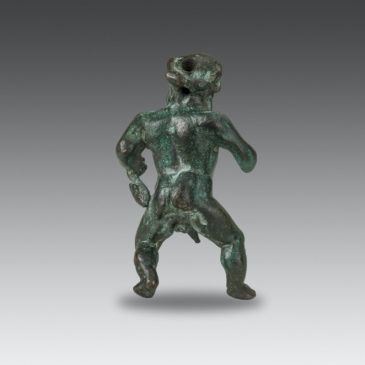
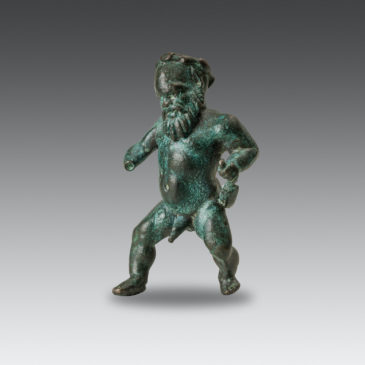
In very good condition with superb patina even if the right hand is lost.

He is identified as Silenus by his pointed ears, snub nose, and the wavy incisions on his body, which indicate that he was once hairy. His head is crowned, and in his left hand he holds a bunch of grapes.

Roman, Roman Imperial
1st century A.D., 2nd century A.D.
H : 7 cm

Price:CHF 9'100

Categories: Metalwork, Sculpture. Tags: Bronze, Dwarf, Roman, Rome, Silene, Statuette, Statuette of a Dwarf Silene.

Love it, share it!

  • Description
  • Additional information
  • Product Inquiry

Product Description

The statuette was cast in solid iron using the lost-wax technique. At the back of the head, a long hole pierces the nape of the neck: its purpose cannot be explained with certainty, but it is thought to have been part of the mechanism used to attach the statuette to its original support (an ornament for a candelabrum or a vessel, part of a small group of statuettes depicting Dionysian subjects, etc.). The Silenus, whose body is leaning backward, cannot stand on his own: his legs are slightly bent, the right one is stepped forward, while the left one is set back, as if the figure were dancing or skipping.

The statuette displays exceptional technical and artistic quality: the anatomical details are highly realistic and rendered through remarkable sculptural craftsmanship, which precisely alternates between well-modeled forms and small indentations.

He is identified as Silenus by his pointed ears, snub nose, and the wavy incisions on his body, which indicate that he was once hairy. His head is crowned, and in his left hand he holds a bunch of grapes.

The proportions of the figurine are typical of ancient depictions of dwarfs. Although the ancients did not have the scientific means to describe the various forms of physical abnormalities known as dwarfism, they were able to portray their most obvious external characteristics. Among the various known forms of this condition, disproportionate dwarfism (achondroplasia) is the one that appears most frequently in nature as well as in Greco-Roman iconography: depictions of dwarfs are generally characterized by disproportionate limbs, an oversized head, a flat face, a prominent belly and buttocks, a tendency toward obesity, and possibly a spinal deformity, among other features. Another common anomaly in iconography—though one with no scientific basis—is the disproportionately large size of the genitals.

Several characteristics of dwarfism are evident in the statuette under examination: the unusual proportions of the legs and arms, which are too short and muscular; the head, which is too large; the partially twisted legs; the slightly protruding belly; and the arched back.
Like hunchbacks, dwarfs feature prominently in the “grotesque” depictions of Greco-Roman art: their frequency is, in fact, well above the average number of people actually affected by this condition. This phenomenon is likely explained by the the belief that people with such disabilities had apotropaic and lucky-charm properties; the abnormal size of their genitals is likely explained by the same belief.

Imperial Romain Bronze Statuette of a Dwarf Silene from the 1st-2nd century A.D. In very good condition with superb patina even if the right hand is lost.

Additional information

Culture

Roman, Roman Imperial

Datation

1st century A.D., 2nd century A.D.

Dimensions

H : 7 cm

Type

Metalwork, Sculpture

Material

Bronze

Colors

Green

Condition

Complete and in good condition even if the right hand is lost. Brown and green patina.

Serial Number

20965

Other Products

  • Statuette of an Elephant
    Details Add to cart
    ADDED

    Statuette of an Elephant

    Statuette of an Elephant

    Carved from a small limestone monolith, this statuette is certainly one of the first three-dimensional images of elephant in Near Eastern art; moreover, these large mammals were rarely represented in the rich animal iconography of this prominent culture.

    CHF 7'800 Read More
  • Greek terracotta figure showing the myth of Europe
    Details Add to cart
    ADDED

    Greek terracotta figure showing the myth of Europe

    Greek terracotta figure showing the myth of Europe

    The group comprises two figures: with natural grace, a young woman rides astride a bull that is galloping rapidly towards the viewer’s right. Indeed, the young woman is Europa (the mythological figure after whom our continent is named), who was one of the three daughters of the King of Tyre (a major Phoenician coastal city). She was abducted by Zeus on the beach where she was playing with her sisters: the god appeared to her in the form of a magnificent white bull and carried her, riding the waves of the sea, all the way to Crete.

    CHF 8'500 Read More
  • Grotesque Terracotta Head (Mime or Actor)
    Details Add to cart
    ADDED

    Grotesque Terracotta Head (perhaps a Mime or an Actor)

    Grotesque Terracotta Head (perhaps a Mime or an Actor)

    The statuettes of “grotesques” often represented mimes, street actors, music players, dancers, or even street vendors or workers suffering from physical deformities or afflictions that the sculptors treated in an exaggerated manner, to create a caricature-like effect. At the end of the Hellenistic period, in the large urban centers such as Rome and Alexandria, the theatrical genre of pantomime (according to tradition, this genre was created by Sophron of Syracuse in the 5th century B.C. already) was very popular.

    CHF 8'200 Read More

Blog

Antique Idols

As soon as humans were able to think, they consistently […]

Antiquity’s Colors

English Translation Soon Les œuvres qui nous sont parvenues de […]

Glassware production

Glass, a luxury and exquisite material, whose technical virtuosity reached […]

Categories

  • Artifacts
  • Events & exhibitions
  • Facts & Figures
  • The gallery
  • FAQs
  • Terms of Use
  • Terms of Sale
  • Contact us

©Designed by Webgenève - Création de site internet


Rue Etienne Dumont, 9 1204 Geneva
Tel. +4122 301 9378
Email: contact@young-collectors.com

This website uses cookies. If you continue browsing this website, your action is considered to be a cookie policy acceptance.
