
Pyxis with its lid

Pyxis with its lid
Pyxis with its lid
This piece is a fine example of Bactrian craftsmanship from the Hellenistic period. It forms part of the long and rich tradition of stonework and inlay that flourished in this remote region of Western Asia as early as the Early Bronze Age.
2nd century B.C., 3rd century B.C.
Diam : 18.5 cm
In stock
Product Description
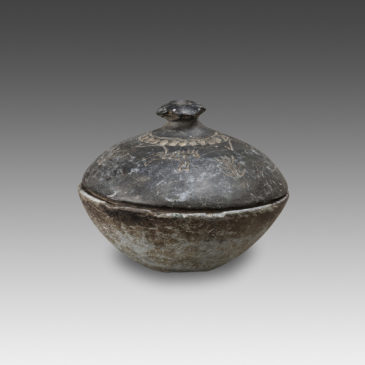
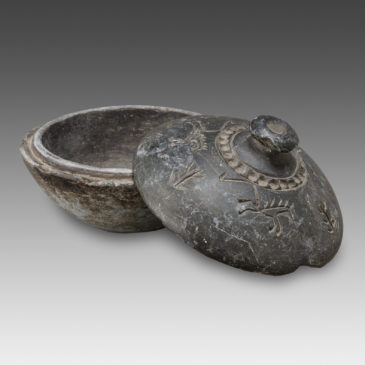
This box (or pyx, to use the term derived from Ancient Greek) has a lid which fits perfectly onto the body thanks to a raised, sculpted rim on the lip.
The body, with a slightly flattened base, is hemispherical in shape but flattened; its lid, with a domed profile, is fitted with a low, cylindrical central handle, topped by a circular, mushroom-shaped knob.
The decoration is limited to an elegant and simple frieze incised on the upper part of the lid: three stylised horses, galloping at full speed, alternate with three plant motifs depicting a small bush.
This piece is a fine example of Bactrian craftsmanship from the Hellenistic period. It forms part of the long and rich tradition of stonework and inlay that flourished in this remote region of Western Asia as early as the Early Bronze Age. The lids of these boxes (which were sometimes divided internally into two, three or four compartments) are often decorated with simple, highly stylised animal, geometric or floral motifs, featuring inlays of white, yellowish or reddish stone. The formal and decorative similarities suggest that there were probably workshops specialising in the production of these objects.
These were typically feminine objects, which could be used either as containers for cosmetics (the smallest boxes) or as jewellery boxes.


