
Ancient Art and Antiquities For Sale

Cart

View Cart
  • No products in the cart.
  • My Account
    • Edit address
    • Change password
    • View order
  • English
  • Login / Register
  • HOME
  • SHOP
  • ABOUT US
  • BLOG
  • CONTACT
  • BILIANAK.
  • PHOENIX ANCIENT ART
Back to top

Near Eastern Faience Flask

Home  / Vessels / Near Eastern Faience Flask
View cart “Globular Jar” has been added to your cart.
  • Near Eastern Faience Flask
  • Near Eastern Faience Flask

Near Eastern Faience Flask

Near Eastern Faience Flask

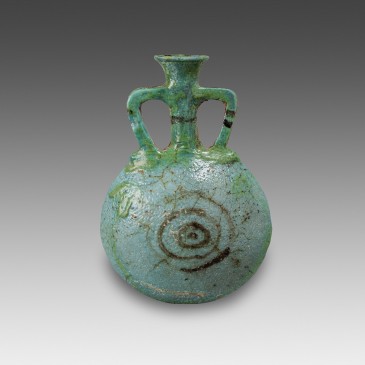
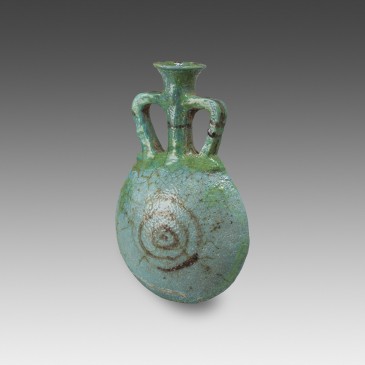
A vase with a distinctive appearance, as its circular body consists of two domed halves, yet its profile is almost flat: the boundary between the two halves is highlighted by a ridge.

Bronze Age, Near Eastern
13th century B.C., 14th century B.C.
H: 9.7 cm

In stock

In stock

Price:CHF 2'700

Category: Vessels. Tags: Bronze Age, Faience, Flask, Near Eastern, Near Eastern Faience Flask, Turquoise.

Love it, share it!

  • Description
  • Additional information
  • Product Inquiry

Product Description

A vase with a distinctive appearance, as its circular body consists of two domed halves, yet its profile is almost flat: the boundary between the two halves is highlighted by a ridge. The neck, shaped like a small column, tapers to a funnel-shaped opening; it is reinforced by two square-sectioned handles. The decoration, rendered in black, consists solely of series of concentric circles painted on both sides and lines on the neck, handles, and rim.

This type of vase, which originated in the Near East, has a long history dating back at least to the 2nd millennium B.C. and continuing throughout the following millennium; its popularity spread to several regions of the ancient world, from Egypt to the Near East, and from Cyprus and Rhodes to the Aegean world. The most famous examples are the “New Year’s gourds,” which enjoyed great popularity in Egypt during the Saite Period (7th–6th centuries B.C.): they were associated with the festival on July 19 that celebrated the beginning of the Nile flood.

In the Late Bronze Age, the lenticular gourd appeared in a turquoise faience version with black decoration at sites along the Syrian-Palestinian coast (for example, at Ugarit) as well as in Egypt, featuring either simple decoration, as seen here, or, at times, more elaborate designs with figurative scenes. Terracotta versions belong to the repertoire of Cretan (Minoan period) and Greek pottery from the Mycenaean period (phases IIIB and IIIC, 14th–12th centuries BCE): their decoration is most often linear.

Given their rather small size and relatively low capacity, it is likely that these flasks contained cosmetic and semi-precious substances such as perfumes.

Additional information

Culture

Bronze Age, Near Eastern

Datation

13th century B.C., 14th century B.C.

Dimensions

H: 9.7 cm

Type

Vessel

Material

Faience

Colors

Black, Turquoise

Condition

Good condition.

Serial Number

23238

Other Products

  • Details Add to cart
    ADDED

    Small Mycenaean Pear-Shaped Jar

    Small Mycenaean Pear-Shaped Jar

    Skillfully wheel-made vessel provided with three handles that were modeled separately and applied to the shoulder before the firing process.

    This vessel with a sinuous profile and a circular, narrow base is very characteristic of Mycenaean culture: it is the reduced version of the large jars that can often be found in tombs and that would have served for the storage of the products used during funerary rituals.

    CHF 4'000 Read More
  • Details Add to cart
    ADDED

    Near Eastern Spouted Bowl

    Near Eastern Spouted Bowl

    This hemispherical vessel is provided, near the lip, with a horizontal, perfectly cylindrical spout. It is simply decorated with a frieze of zigzag pattern in relief. Despite its reduced size, this vessel is outstanding for its technical precision: all the details of the shape and decoration were carefully executed.

    CHF 1'800 Read More
  • Details Add to cart
    ADDED

    Bactrian Alabaster Chalice

    Bactrian Alabaster Chalice

    This object, whose shape recalls a chalice, was carved from a monolith of calcite (alabaster) that is similar in color and appearance to the stone commonly used by Egyptian sculptors for luxury tableware in the late 4th millennium B.C. already.

    CHF 7'800 Read More

Blog

Antique Idols

As soon as humans were able to think, they consistently […]

Antiquity’s Colors

English Translation Soon Les œuvres qui nous sont parvenues de […]

Glassware production

Glass, a luxury and exquisite material, whose technical virtuosity reached […]

Categories

  • Artifacts
  • Events & exhibitions
  • Facts & Figures
  • The gallery
  • FAQs
  • Terms of Use
  • Terms of Sale
  • Contact us

©Designed by Webgenève - Création de site internet


Rue Etienne Dumont, 9 1204 Geneva
Tel. +4122 301 9378
Email: contact@young-collectors.com

This website uses cookies. If you continue browsing this website, your action is considered to be a cookie policy acceptance.
