
Ionian Lip Cup

Ionian Lip Cup
Greek Archaic Ionian Lip Cup
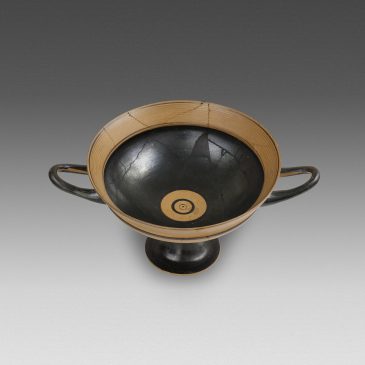
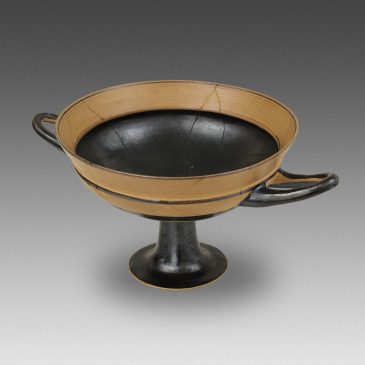
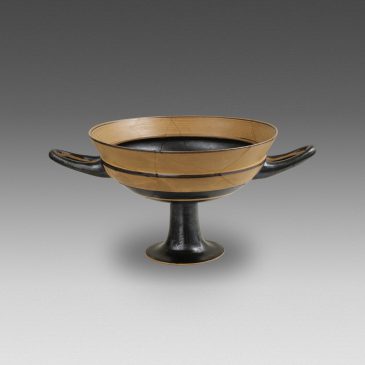
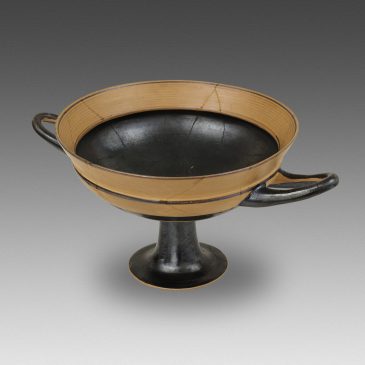
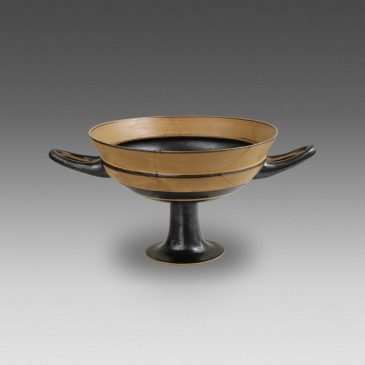
The cup (kylix), of medium size but with elegant and harmonious proportions, rests on a tall, hollow stem shaped like a trumpet. The decoration, very elegant and understated, relies solely on a chiaroscuro effect, based on the alternation of lines and areas that are either painted or left unpainted, without figures or plant motifs.
half of the 6th century B.C.
H : 10,2 cm – Diam : 20,3 cm (with handles)
In stock
Product Description
The cup (kylix), of medium size but with elegant and harmonious proportions, rests on a tall, hollow stem shaped like a trumpet. The bowl is
deep and wide, with a rounded, even contour; the upper part
of the cup features a high rim that slopes slightly outward. The
handles are attached to the top of the bowl, emphasizing the break
in the vase’s profile.
The decoration, very elegant and understated, relies solely
on a chiaroscuro effect, based on the alternation of lines and areas
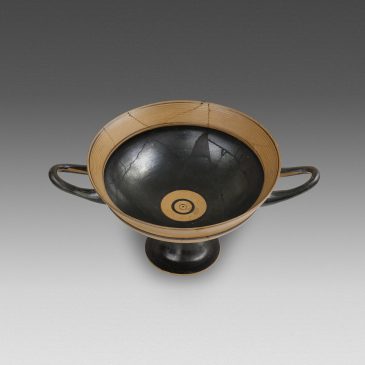
that are either painted or left unpainted, without figures or plant motifs. The central medallion is left unpainted, except for two circles and a central dot painted in black.
The presence of horizontal lines on the inside of the rim is relatively common on Ionian kylikes. This may be explained by the optical effect this pattern creates on the symposiast (banquet participant)—who is already somewhat tipsy—as he drinks from such a vessel: indeed, when the cup was filled with wine, the lines would have given the impression of extending the circular ripples on the surface of the liquid.
Ionian cups with linear decoration are a category of vessels that enjoyed great popularity in the eastern Greek world (they were likely produced in workshops in Miletus and Samos) and in the colonies (colonies along the Black Sea coast, southern Italy, and Sicily), especially between the late 7th and the first half of the 6th century B.C.; after this period, competition from Attic potters supplanted Greco-Eastern and Corinthian productions.
There are many types of Ionian cups (with feet of varying heights, deep or shallower bowls, bottoms that are almost entirely black or left unpainted, and the use of white and purple for certain lines, etc.), with average dimensions ranging from 12 to 16 cm in diameter. In terms of its shape, the piece under examination resembles the Attic rimmed bowls known as “Petits Maîtres,” which were in vogue throughout the Greek world during the middle decades of the 6th century BCE.


