
Ancient Art and Antiquities For Sale

Cart

View Cart
  • No products in the cart.
  • My Account
    • Edit address
    • Change password
    • View order
  • English
  • Login / Register
  • HOME
  • SHOP
  • ABOUT US
  • BLOG
  • CONTACT
  • BILIANAK.
  • PHOENIX ANCIENT ART
Back to top

Byzantine Terracotta Oil lamp

Home  / Vessels / Lamps / Byzantine Terracotta Oil lamp

View cart “Miniature Feminine Statuette” has been added to your cart.

Byzantine Terracotta Oil lamp

Byzantine Terracotta Oil lamp

The shape, style and decoration of this example are typical of lamps produced during the final centuries of the Empire and the early Byzantine period: the most active workshops were located in North African cities, but their
products were often imitated elsewhere, notably in Italy and Gaul.

Byzantine
Half of the 5th - begining of the 7th century A.C.
L : 12.8 cm

In stock

In stock

Price:CHF 1'100

Category: Lamps. Tags: Byzantine, lamp, Oil, terracotta.

Love it, share it!

  • Description
  • Additional information
  • Product Inquiry

Product Description

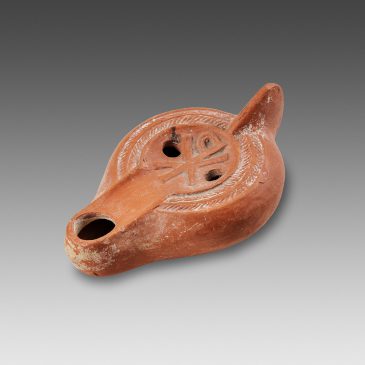
The lamp was moulded from a fine, brick-coloured clay and covered with a bright orange slip. The circular body is extended by a long, rounded channel, featuring a hole for the wick to emerge. A small, sturdy, hand-made handle is attached to the back. The base consists of a flat ring with a cord running up to the handle. The medallion features two parallel filling holes.

The decoration is confined to the medallion: a band adorned with a long fishbone surrounds one of the most widespread Christian iconographic motifs, the Constantinian chi-rho (here with the rho facing left). This symbol, composed of the first two letters of Christ’s name written in Greek (Χ, chi, and Ρ, rho), is most often associated with the first emperor to proclaim himself a Christian, Constantine the Great (emperor from 306 to 337 AD).

The shape, style and decoration of this example are typical of lamps produced during the final centuries of the Empire and the early Byzantine period: the most active workshops were located in North African cities, but their
products were often imitated elsewhere, notably in Italy and Gaul. Their remarkable success was undoubtedly due to their rich iconography, generally linked to Christian beliefs (scenes from the Old Testament, symbols such as the lamb, the dove, the fish, the palm tree or the chi-rho).

Additional information

Culture

Byzantine

Datation

Half of the 5th – begining of the 7th century A.C.

Dimensions

L : 12.8 cm

Type

Lamps

Material

Terracotta

Colors

Amber

Condition

Complete and virtually intact; some incrustations, small chips.

Serial Number

34194

Other Products

  • Hunchback Statuette
    Details Add to cart
    ADDED

    Hunchback Statuette (?)

    Hunchback Statuette (?)

    Hand-modelled, the sculpture depicts a figure of indeterminate gender, characterised above all by the obvious deformation of its spine: its back forms a large hump, emphasised by the spine, which is slightly raised, and by the rendering of the ribs, painted dark brown. This deformity causes the figure’s torso to lean abnormally forwards and to the left.

    CHF 3'200 Read More
  • Greek terracotta figure showing the myth of Europe
    Details Add to cart
    ADDED

    Greek terracotta figure showing the myth of Europe

    Greek terracotta figure showing the myth of Europe

    The group comprises two figures: with natural grace, a young woman rides astride a bull that is galloping rapidly towards the viewer’s right. Indeed, the young woman is Europa (the mythological figure after whom our continent is named), who was one of the three daughters of the King of Tyre (a major Phoenician coastal city). She was abducted by Zeus on the beach where she was playing with her sisters: the god appeared to her in the form of a magnificent white bull and carried her, riding the waves of the sea, all the way to Crete.

    CHF 8'500 Read More
  • Askos with a Linear Decoration
    Details Add to cart
    ADDED

    Askos with a Linear Decoration

    Daunian Askos with a Linear Decoration

    The word askos originally designates the skin of an animal that was sewn and turned into a skin intended to carry liquids, especially wine or water. This example, whose spherical shape with a large vertical neck recalls a wineskin, is a typical production of Daunian ceramists

    CHF 9'000 Read More

Blog

Antique Idols

As soon as humans were able to think, they consistently […]

Antiquity’s Colors

English Translation Soon Les œuvres qui nous sont parvenues de […]

Glassware production

Glass, a luxury and exquisite material, whose technical virtuosity reached […]

Categories

  • Artifacts
  • Events & exhibitions
  • Facts & Figures
  • The gallery
  • FAQs
  • Terms of Use
  • Terms of Sale
  • Contact us

©Designed by Webgenève - Création de site internet


Rue Etienne Dumont, 9 1204 Geneva
Tel. +4122 301 9378
Email: contact@young-collectors.com

This website uses cookies. If you continue browsing this website, your action is considered to be a cookie policy acceptance.
