
Ancient Art and Antiquities For Sale

Cart

View Cart
  • No products in the cart.
  • My Account
    • Edit address
    • Change password
    • View order
  • English
  • Login / Register
  • HOME
  • SHOP
  • ABOUT US
  • BLOG
  • CONTACT
  • BILIANAK.
  • PHOENIX ANCIENT ART
Back to top

Globular Jar

Home  / Vessels / Globular Jar

View cart “Roman Ribbed Glass Bowl without Handles” has been added to your cart.

Globular Jar

Near Eastern Globular Jar

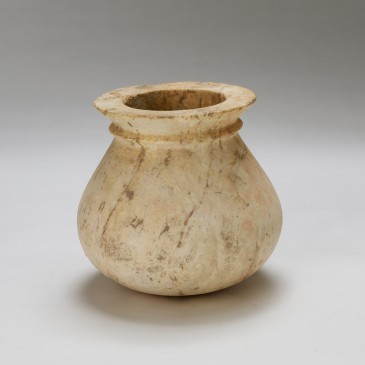
Such jars are largely documented all throughout the Near Eastern world. Our example is in the shape of a drop; the regular, rounded profile of the body is only interrupted in the upper part by a sharp, thick ridge on the neck. The circular mouth is delineated by a flat, angular lip.

Near Eastern, Sumerian
3rd millenium B.C.
H: 15.4 cm

In stock

In stock

Price:CHF 3'200

Category: Vessels. Tags: Near Eastern, Stone, Sumerian, Vase, Vessel.

Love it, share it!

  • Description
  • Additional information
  • Product Inquiry

Product Description

Such jars are largely documented all throughout the Near Eastern world. Our example is in the shape of a drop; the regular, rounded profile of the body is only interrupted in the upper part by a sharp, thick ridge on the neck. The circular mouth is delineated by a flat, angular lip.

The capacity of the vessel is less important as might have been expected, since its interior is a simple cylindrical tube that does not follow the curvature of the outer profile: this jar would have therefore been intended to store a liquid product or an ointment, which would have served as cosmetic or during rituals. The lid, which would have been made of clay or of a perishable material, could be attached under the lip, by tightening a string perhaps.

The carver certainly used a rotating technique, probably employing some sort of lathe: the vessel was hollowed out using a bow drill and polished with sand or a harder stone.

Stone was largely used in ancient times for the manufacture of containers of various shapes and sizes: stone vases, considered as luxury goods, were used in everyday life, but were also found in the tombs of high-ranking individuals and in the treasures of sanctuaries. The ancient iconography of the Egyptian funerary paintings seems to indicate that the stone carvers started by stabilizing the vase in a hole in the ground or on a worktable. Then they sculpted and polished the exterior before hollowing out the interior with a drill.

Additional information

Culture

Near Eastern, Sumerian

Datation

3rd millenium B.C.

Dimensions

H: 15.4 cm

Type

Vessel

Material

Limestone

Colors

White

Condition

In excellent state of preservation; chipped lip, cracks and superficial breaks.

Serial Number

12749

Other Products

  • Roman Small Glass Cup (Patella)
    Details Add to cart
    ADDED

    Roman Small Glass Cup (Patella)

    Roman Small Glass Cup (Patella)

    This small cup, which belonged to a famous collection of the 19th century, was mold-blown in a transparent glass with an originally bluish tinge.

    Used as tableware, these small cups served as drinking vessels but would have also been intended to contain various substances: sauces, spices, other condiments, etc. Produced mainly between the early Flavian period and the early 2nd century A.D., they exist in different versions that vary in the color, in the type of glass, or in details of the shape (shape of the lip, more or less rounded body, etc.).

    CHF 15'000 Read More
  • Large Bowl (Tell Minis Type)
    Details Add to cart
    ADDED

    Large Bowl (Tell Minis Type)

    Large Bowl (Tell Minis Type)

    To the eyes of the modern viewer, this large glazed ceramic bowl is outstanding for its aesthetic qualities resulting from the formal simplicity and the turquoise color.

    CHF 7'500 Read More
  • Details Add to cart
    ADDED

    Small Bowl

    Hellenistic Small Glass Bowl

    This core-formed bowl is simply decorated with lathe-cut grooves just below the lip. The base is slightly concave. Towards the end of the Hellenistic period, glass definitely supplanted clay as a raw material for the manufacture of containers in all areas of daily life. With versatility like no other known material in ancient times, abundant availability, lightness and ease of use, glass enabled the imitation of a wide range of other materials (precious metals especially), whether in the form, the design or the color.

    CHF 1'400 Read More

Blog

Antique Idols

As soon as humans were able to think, they consistently […]

Antiquity’s Colors

English Translation Soon Les œuvres qui nous sont parvenues de […]

Glassware production

Glass, a luxury and exquisite material, whose technical virtuosity reached […]

Categories

  • Artifacts
  • Events & exhibitions
  • Facts & Figures
  • The gallery
  • FAQs
  • Terms of Use
  • Terms of Sale
  • Contact us

©Designed by Webgenève - Création de site internet


Rue Etienne Dumont, 9 1204 Geneva
Tel. +4122 301 9378
Email: contact@young-collectors.com

This website uses cookies. If you continue browsing this website, your action is considered to be a cookie policy acceptance.
