
Ancient Art and Antiquities For Sale

Cart

View Cart
  • No products in the cart.
  • My Account
    • Edit address
    • Change password
    • View order
  • English
  • Login / Register
  • HOME
  • SHOP
  • ABOUT US
  • BLOG
  • CONTACT
  • BILIANAK.
  • PHOENIX ANCIENT ART
Back to top

Roman Amber Glass Perfume Bottle

Home  / Glass / Roman Amber Glass Perfume Bottle
View cart “Sumerian Circular Stone Bowl” has been added to your cart.
  • Roman Amber Glass Perfume Bottle
  • Roman Amber Glass Perfume Bottle

Roman Amber Glass Perfume Bottle

Roman Amber Glass Perfume Bottle

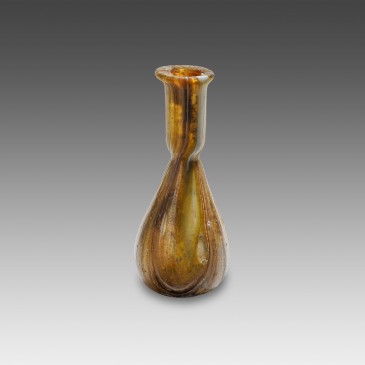
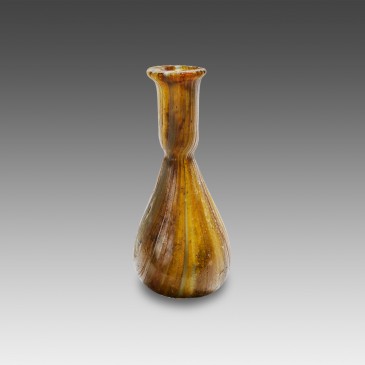
This example was blown in a gold-amber glass with beautiful and varied white streaks. The slightly asymmetrical shape is characterized by a piriform body, which tapers in the upper part and terminates in a cylindrical neck and a flat lip.

Roman
1st century A.D.
H: 8.2 cm

In stock

In stock

Price:CHF 2'400

Categories: Glass, Vessels. Tags: Bottle, Glass, Roman, Roman Amber Glass Perfume Bottle.

Love it, share it!

  • Description
  • Additional information
  • Product Inquiry

Product Description

This example was blown in a gold-amber glass with beautiful and varied white streaks. The slightly asymmetrical shape is characterized by a piriform body, which tapers in the upper part and terminates in a cylindrical neck and a flat lip. The flattened bottom does not provide the vessel with good balance. The tapering neck would have served to hang the bottle from a string.

Largely widespread from the early Imperial period, these small bottles were mass-produced using the technique of glassblowing: they nevertheless show significant variations in the shape and in the color of the glass, which make each piece almost unique.

Also known as balsamaria, these small flasks were intended for the transport and storage of the perfumes, or perfumed oils, that were widely used by the Romans in their daily life. The analysis of the remains collected in preserved vessels indicates that these cosmetics were composed of oil or wax associated with various plant essences.

Glassblowing was introduced towards the middle of the 1st century B.C. in the Syrian-Palestinian region, and later spread all throughout the Mediterranean basin. This technical innovation completely transformed the glass industry, since it enabled glassmakers to produce tableware and storage containers in a much wider variety, and more easily and quickly than ever before. From the late Hellenistic period, glass definitely supplanted clay as a raw material for the manufacture of vessels in all areas of daily life.

Additional information

Culture

Roman

Datation

1st century A.D.

Dimensions

H: 8.2 cm

Type

Glass, Vessel

Material

Glass

Colors

Amber

Condition

Complete and in excellent state of preservation, despite a minor wear and superficial bubbles.

Serial Number

14415

Other Products

  • Roman Small Glass Cup (Patella)
    Details Add to cart
    ADDED

    Roman Small Glass Cup (Patella)

    Roman Small Glass Cup (Patella)

    This small cup, which belonged to a famous collection of the 19th century, was mold-blown in a transparent glass with an originally bluish tinge.

    Used as tableware, these small cups served as drinking vessels but would have also been intended to contain various substances: sauces, spices, other condiments, etc. Produced mainly between the early Flavian period and the early 2nd century A.D., they exist in different versions that vary in the color, in the type of glass, or in details of the shape (shape of the lip, more or less rounded body, etc.).

    CHF 15'000 Read More
  • Details Add to cart
    ADDED

    Sumerian Circular Stone Bowl

    Near Eastern-Sumerian Circular Stone Bowl

    A conical bowl, with a perfectly flat circular bottom that provides a good balance to the vessel. Flat and angular lip. The mottled stone, covered with small darker inclusions, gives the surface a unique and original decoration. The vessel has an accurate, perfectly regular shape; it would have been shaped using a potter’s wheel, and hollowed out by drilling.

    CHF 1'350 Read More
  • Details Add to cart
    ADDED

    Small Bowl

    Hellenistic Small Glass Bowl

    This core-formed bowl is simply decorated with lathe-cut grooves just below the lip. The base is slightly concave. Towards the end of the Hellenistic period, glass definitely supplanted clay as a raw material for the manufacture of containers in all areas of daily life. With versatility like no other known material in ancient times, abundant availability, lightness and ease of use, glass enabled the imitation of a wide range of other materials (precious metals especially), whether in the form, the design or the color.

    CHF 1'400 Read More

Blog

Antique Idols

As soon as humans were able to think, they consistently […]

Antiquity’s Colors

English Translation Soon Les œuvres qui nous sont parvenues de […]

Glassware production

Glass, a luxury and exquisite material, whose technical virtuosity reached […]

Categories

  • Artifacts
  • Events & exhibitions
  • Facts & Figures
  • The gallery
  • FAQs
  • Terms of Use
  • Terms of Sale
  • Contact us

©Designed by Webgenève - Création de site internet


Rue Etienne Dumont, 9 1204 Geneva
Tel. +4122 301 9378
Email: contact@young-collectors.com

This website uses cookies. If you continue browsing this website, your action is considered to be a cookie policy acceptance.
