
Egyptian faience ushabti of Queen Henuttawy
Egyptian, Third Intermediate Period, 21st Dynasty, ca. 1000 B.C.
Depicted mummiform, bright blue in color, with details in black, including the eyes and brows, a fillet in her hair and a hoe in each of her fisted hands, with six rows of hieroglyphs, reading: “Instructions of the Osiris, the Divine Adoratress Henut-tawy, She says: ‘O these shabty!” and continuing with a form of the standard shabti text from Chapter 6 of The Book of the Dead.
Ancient Attic Greek Black-Figure Lekythos
This lekythos is a tall vessel with a single handle attached to the broad shoulder terminating in a narrow neck and a rather large, semi-spherical mouth covered in black. The lower part of the body and a circular foot are also painted in black. The neck received a delicate decoration of tendrils of ivy with typical heard-shape leaves and stylized berries; it is separated from the shoulder by a band of tongues. The shoulder has a chain of seven, prominently painted palmettes.
Ancient Corinthian Greek Terracotta Lekanis with Panthers, a Sphinx, and Harpies
The lekanis has twin spurred handles on either side of a shallow footed bowl, decorated by three rows of red pomegranates along the rim and a series of red, black, and clay colored bands below
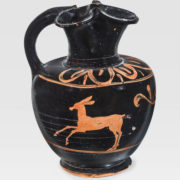
Ancient Apulian Xenon Ware Oinochoe
A trefoil oinochoe with spreading foot and cylindrical handle, The body painted with a deer and an inverted palmette flanked by scrolls, egg-and-dart on the shoulder.
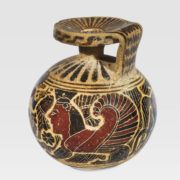
Ancient Corinthian Terracotta Aryballos with Warriors in combat
Attributed to the Warrior Group
The spherical aryballos depicts two hoplite figures in combat, flanked on one side by a seated sphinx and a horseman on the other. Rosettes and amorphous shapes decorate the remaining planes, with many details painted in red throughout. Tongues adorn the top of the rim and shoulder, zig-zags band along the handle, and a whirl with recessed center features on the underside.
Guttus with Spout and Strainer
A small drinking vessel known as a ‘guttus’. It is a small container designed to fill other vessels, such as oil lamps, via its spout located on the body (which is slender and tapered on the vase in question). As its name suggests, the liquid flowed from it only in small quantities or drop by drop.The shape, size and technique thus allow us to date the production of this vase to Magna Graecia, during the first half of the 4th century BC.
Hunchback Statuette (?)
Hand-modelled, the sculpture depicts a figure of indeterminate gender, characterised above all by the obvious deformation of its spine: its back forms a large hump, emphasised by the spine, which is slightly raised, and by the rendering of the ribs, painted dark brown. This deformity causes the figure’s torso to lean abnormally forwards and to the left.
Polychrom Askos with two necks
A small but charming example of an ‘askos’ form, one of the most significant in Daunian pottery from the early Hellenistic period. Here, the usual wide neck is complemented by a second, symmetrical spout, fitted with a strainer and positioned at the rear of the body.
Pyxis with its lid
This piece is a fine example of Bactrian craftsmanship from the Hellenistic period. It forms part of the long and rich tradition of stonework and inlay that flourished in this remote region of Western Asia as early as the Early Bronze Age.
Bottle with Decorations
With no handles, this richly decorated bottle has a spherical yet flattened body, supported by a small ring-shaped base. It was probably used for serving drinks, as a piece of tableware.
Greek Archaic Ionian Lip Cup
The cup (kylix), of medium size but with elegant and harmonious proportions, rests on a tall, hollow stem shaped like a trumpet. The decoration, very elegant and understated, relies solely on a chiaroscuro effect, based on the alternation of lines and areas that are either painted or left unpainted, without figures or plant motifs.
Islamic Vessel with Floral Decoration
The vessel, wheel-thrown, is made of light grey-beige clay covered with a white engobe. The decoration appears to be painted in black beneath a magnificent turquoise glaze, which is slightly thicker on the base where it has partially built up.
The technique, form and decoration are characteristic of the highly glossy ceramics produced in the workshops of the city of Kashan, situated in the centre of present-day Iran.
©Designed by Webgenève - Création de site internet

Rue Etienne Dumont, 9 1204 Geneva
Tel. +4122 301 9378
Email: contact@young-collectors.com