
Ancient Corinthian Greek Terracotta Lekanis with Panthers, a Sphinx, and Harpies
The lekanis has twin spurred handles on either side of a shallow footed bowl, decorated by three rows of red pomegranates along the rim and a series of red, black, and clay colored bands below
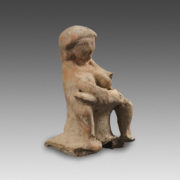
Statuette of a women breast-feeding a child
This statuette belongs to a significant series of figurines with similar characteristics originating from the Phoenician and Punic worlds. Generally dated to the 7th–6th centuries B.C., they may be standing or seated, holding a child or various attributes (musical instruments, a fan, ears of grain, etc.) or simply holding their breast or belly: in the latter case, they are often called dea gravida
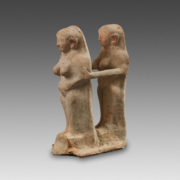
Group of two feminine statuettes
Levantine terracotta Group of two feminine statuettes from the 7th-6th century B.C. Complete and in good condition. Big chips on the basis. Concretion and few polychromy remains (brown-red).
This group belongs to a significant series of figurines with similar characteristics originating from the Phoenician and Punic worlds. Generally dated to the 7th–6th centuries B.C., they may be standing or seated, carrying a child or various attributes (musical instruments, a fan, ears of grain, brooches, etc.) or simply holding their breast or belly: in the latter case, they are often called dea gravida.
Olpe with volute handle
The olpe is made of silver sheet. Its body, shaped like a teardrop, is supported by a low, truncated conical foot; its rounded shoulder tapers into a low, flared neck. With its airy, sinuous outline, the handle lends the vessel an even more elegant shape.
Black-Figure Lekythos
This lekythos has a rather stocky, rounded shape. It has a handle that forms a loop above the shoulder. The rim is flared and the neck is cylindrical and elongated. The base is circular and hollow.
Iapygian Spherical Jug
The shape and style allow this vessel – a known but relatively rare type – to be dated to the early phase of Daunian pottery development, characterised by high-quality pieces and predominantly geometric decoration: the presence of sculptural elements, such as the animal head on this jug, is well documented.
Phrygian Bronze Cup
This bronze cast vessel was polished, while the handles and decorations were hammered and/or decorated in repoussé.
Mummy Faience Bead Mask
This mask, delineated by three fringes of white, red and black beads, clearly highlights the anatomical details connected with the senses: the ears, the eyes with the black irises, the nose and the mouth made of red beads.
©Designed by Webgenève - Création de site internet

Rue Etienne Dumont, 9 1204 Geneva
Tel. +4122 301 9378
Email: contact@young-collectors.com