
Necklace composed of Painted Beads (“Etched” Beads)

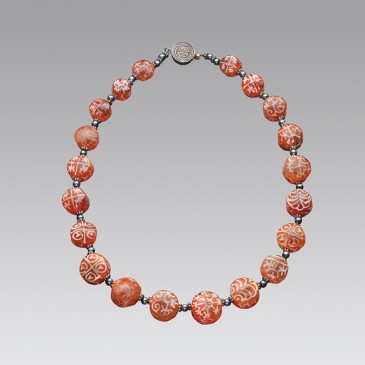
Necklace composed of Painted Beads (“Etched” Beads)
This necklace is composed of twenty cylindrical, rounded beads: their size and color, ranging from coral-red to reddish brown, are rather uniform.
3rd millenium B.C.
D: btw. 1.0 and 1.5 cm
Out of stock
Product Description
This necklace is composed of twenty cylindrical, rounded beads: their size and color, ranging from coral-red to reddish brown, are rather uniform. Each bead is decorated with geometric patterns painted in white, hence the term “etched beads” in English. They are produced by heating several times (up to twelve times, to about 200-300 degrees) pebbles of a specific type of agate: this process gives them their intense red color. The white patterns are obtained by applying to the surface a layer of a paste made of sodium bicarbonate, which, once heated, becomes virtually indelible.
Cornelian beads (which exist in all shapes, painted or undecorated) enjoyed remarkable success during the 3rd millennium B.C. especially, since they can be found all throughout the known world at the time: the Indus Valley, the Iranian plateau, Bactria, Near East, Egypt.
Necklaces and pendants are a very particular type of archaeological material: they can be easily carried far away from where they were originally produced, and the permanence of the stone (which preserved them for so long), as well as the lost thread (threads were made of perishable materials, such as leather or plant fibers) often make their classification difficult and uncertain.


