
Ancient Art and Antiquities For Sale

Cart

View Cart
  • No products in the cart.
  • My Account
    • Edit address
    • Change password
    • View order
  • English
    • Français
  • Login / Register
  • HOME
  • SHOP
  • ABOUT US
  • BLOG
  • CONTACT
  • BILIANAK.
  • PHOENIX ANCIENT ART
Back to top

Necklace composed of Painted Beads (“Etched” Beads)

Home  / Jewelry / Necklace composed of Painted Beads (“Etched” Beads)

View cart “Ring With Hermes/Mercury” has been added to your cart.
  • Necklace composed of Painted Beads ("Etched" Beads)

Necklace composed of Painted Beads (“Etched” Beads)

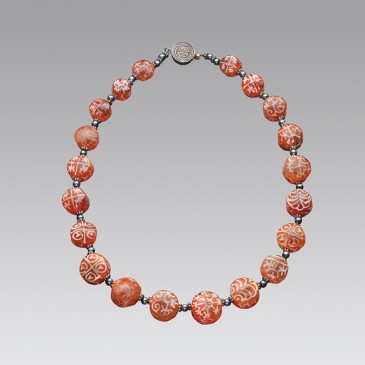
This necklace is composed of twenty cylindrical, rounded beads: their size and color, ranging from coral-red to reddish brown, are rather uniform.

Indus Valley
3rd millenium B.C.
D: btw. 1.0 and 1.5 cm

Out of stock

Category: Jewelry. Tag: Necklace composed of Painted Beads ("Etched" Beads).

Love it, share it!

  • Description
  • Additional information
  • Product Inquiry

Product Description

This necklace is composed of twenty cylindrical, rounded beads: their size and color, ranging from coral-red to reddish brown, are rather uniform. Each bead is decorated with geometric patterns painted in white, hence the term “etched beads” in English. They are produced by heating several times (up to twelve times, to about 200-300 degrees) pebbles of a specific type of agate: this process gives them their intense red color. The white patterns are obtained by applying to the surface a layer of a paste made of sodium bicarbonate, which, once heated, becomes virtually indelible.

Cornelian beads (which exist in all shapes, painted or undecorated) enjoyed remarkable success during the 3rd millennium B.C. especially, since they can be found all throughout the known world at the time: the Indus Valley, the Iranian plateau, Bactria, Near East, Egypt.

Necklaces and pendants are a very particular type of archaeological material: they can be easily carried far away from where they were originally produced, and the permanence of the stone (which preserved them for so long), as well as the lost thread (threads were made of perishable materials, such as leather or plant fibers) often make their classification difficult and uncertain.

Additional information

Culture

Indus Valley

Datation

3rd millenium B.C.

Dimensions

D: btw. 1.0 and 1.5 cm

Type

Jewelry

Material

Cornelian

Colors

Orange, Red

Condition

Very good condition, some beads have small holes; the painted patterns slightly faded in places. Reassembled in modern times.

Serial Number

18034

Other Products

  • Details Add to cart
    ADDED

    Twisted Bracelet

    CHF 1'100 Read More
  • Earring representing a Bird
    Details Add to cart
    ADDED

    Earring representing a Bird

    Islamic Earring representing a Bird.

    CHF 3'900 Read More
  • Twisted bracelet
    Details Add to cart
    ADDED

    Twisted bracelet

    This beautiful gold bracelet is embellished by a circular bezel set with an agate. It is composed of a thick, twisted gold wire and of a circular, trapezoidal bezel, which is remarkable both for its width and for its height: this bezel is attached to the bracelet by an elaborate hinge system

    CHF 9'500 Read More

Blog

Antique Idols

As soon as humans were able to think, they consistently […]

Antiquity’s Colors

English Translation Soon Les œuvres qui nous sont parvenues de […]

Glassware production

Glass, a luxury and exquisite material, whose technical virtuosity reached […]

Categories

  • Artifacts
  • Events & exhibitions
  • Facts & Figures
  • The gallery

Archives

  • December 2015
  • June 2015
  • March 2015
  • January 2015
  • December 2014
  • November 2014
  • October 2014
  • September 2014
  • August 2014
  • FAQs
  • Terms of Use
  • Terms of Sale
  • Contact us

©Designed by Webgenève - Création de site internet


Rue Etienne Dumont, 9 1204 Geneva
Tel. +4122 301 9378
Email: contact@young-collectors.com

This website uses cookies. If you continue browsing this website, your action is considered to be a cookie policy acceptance.
