
Polychrom Askos with two necks


Polychrom Askos with two necks
Polychrom Askos with two necks
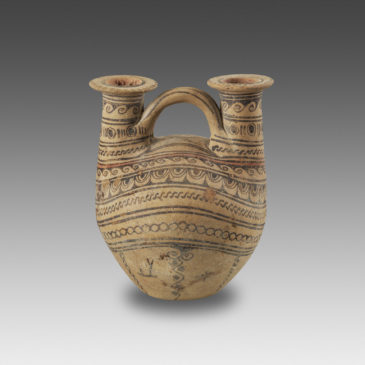
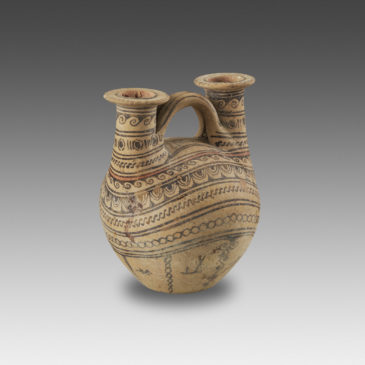
A small but charming example of an ‘askos’ form, one of the most significant in Daunian pottery from the early Hellenistic period. Here, the usual wide neck is complemented by a second, symmetrical spout, fitted with a strainer and positioned at the rear of the body.
3rd century B.C., 4th century B.C.
H : 12.5 cm
In stock
Product Description
A small but charming example of an ‘askos’ form, one of the most significant in Daunian pottery from the early Hellenistic period. Here, the usual wide neck is complemented by a second, symmetrical spout, fitted with a strainer and positioned at the rear of the body.
Originally, the word ‘askos’ referred to an animal’s hide, sewn and fashioned into a bag for carrying liquids, particularly wine or water. In southern Italy, this type of vessel was generally used for funerary purposes. This example, whose shape – despite its small size – is reminiscent of the skin container, is a typical product of the Daunian potters (the style is known as ‘Daunian listata’ because of the brown-black painted bands or listellae): it is notable for its elaborate decoration, featuring geometric and plant motifs perfectly arranged in horizontal friezes separated by double bands.
The term ‘Iapyges’ refers to the various indigenous tribes that inhabited the region corresponding to present-day Puglia. These were subdivided into the Daunians, who occupied the north of the region (the Gargano promontory – the Foggia area), the Peucetians (the central part, the Bari area) and the Messapians (the southern part, present-day Salento).
Relations between the indigenous peoples (who lived inland) and the Greek colonists, who were mainly settled in the coastal towns along the Adriatic, were always fraught with conflict. Stylistically, the development of Daunian pottery followed its own distinct tradition, largely impervious to influences from the contemporary Italiate style (painted using the red-figure technique), which was aimed at people of Greek origin.


