
Ring with the Bust of Askelpios

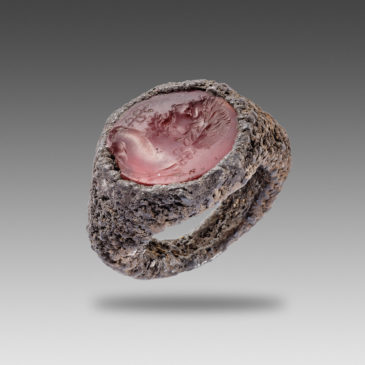
Ring with the Bust of Askelpios
Ring with the Bust of Askelpios
The ring is made of solid silver and is hexagonal in shape, but unfortunately the metal has suffered severe corrosion. It is topped by a circular cabochon, cut from a disc of bright red carnelian, which features, carved into its hollow centre, a magnificent male bust: the figure depicted, seen in left profile, is Asclepius, with a youthful appearance.
1st century A.D., 2nd century A.D.
Diam (inside of ring) : 1.4 cm
In stock
Product Description
The ring is made of solid silver and is hexagonal in shape, but unfortunately the metal has suffered severe corrosion. It is topped by a circular cabochon, cut from a disc of bright red carnelian, which features, carved into its hollow centre, a magnificent male bust: the figure depicted, seen in left profile, is Asclepius, with a youthful appearance. His short but thick hair is rendered by small lines finely engraved into the stone; his beard is short. A wreath of elongated leaves encircles his forehead and is tied at the nape of his neck. A cloak, draped over his largely bare torso, is visible on his right shoulder, from where it falls towards his chest, following the rounded edge of the intaglio.
In addition to the general typology of the image, which corresponds – amongst other possibilities – to depictions of Asclepius/Aesculapius, the Greco-Roman god of medicine, the attribute engraved to the left of the bust confirms the identification: it is a staff with a snake coiled around it. This staff, sometimes known as the caduceus of Asclepius, was believed to have the power to cure diseases: it remains a widely recognised medical symbol to this day. The snake is probably a grass snake.
The intaglio is of exceptional artistic quality.
In ancient mythology, Asclepius played no particular role. He was the son of Apollo and Coronis, the daughter of the king of the Lapiths. To ensure his education, his father entrusted him to the centaur Chiron, who taught him the art of medicine. From Athena, he received as a gift two small vials containing the blood of Medusa, with which Asclepius could cause death and/or resurrect the dead. As the god made use of this gift on several occasions, Hades (the lord of the Underworld) complained to Zeus, who then struck down Apollo’s son with a thunderbolt to preserve the order of the world. However, Zeus transformed Asclepius into a constellation, Ophiuchus.
Asclepius was one of the most popular and revered gods of the ancient world: his principal sanctuary was at Epidaurus, in Argolis, where he healed pilgrims through incubation (a practice that involved sleeping in the sanctuary or temple of the god, who would then convey his instructions to the patient in the form of a dream or a vision).


